











Co-ordinated business investment into Nature-based Solutions can reduce economic risk and unlock growth in the face of environmental disruption
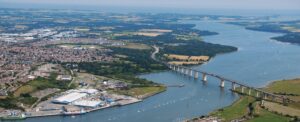
- New report from GFI and Natural Capital East sets out guidance on how businesses and local government can invest regionally in NbS to improve resilience, using Norfolk and Suffolk as a template
London, UK, 19 March 2026 – Norfolk and Suffolk, like many regions across the UK, are experiencing increasing economic risk as water scarcity, pollution and flooding disrupt businesses across sectors including agri-food, development, infrastructure, water and energy. Co-investment in nature-based solutions by businesses and local government offers a nationally replicable model that can reduce these risks and unlock growth,
A new report from the Green Finance Institute (GFI), Developing Regional Economic Resilience through Nature‑based Solutions: Norfolk and Suffolk, outlines how strategic co-investment in nature-based solutions by businesses and local government can support regional growth plans and address water, food and infrastructure threats contributing to economic risk. Presently, national policy barriers, lack of coordination, and critical data gaps are holding back action.
There is an urgent need to create mechanisms that enable multiple businesses, which share risks across a landscape, to strategically co-invest in Nature-based Solutions (NbS), alongside public sector investment – thereby improving resilience for businesses, local communities, and the wider economy.
In the report’s Foreword, Natural Capital East, a collective of leading organisations in East Anglia including Anglian Water, National Grid and Tarmac, calls for a more coordinated approach and co-investment strategy to secure the region’s future economic growth and meet key national security objectives.
The recommendations in the report are applicable across England where acute climate change and nature degradation are negatively impacting business. Although centred on Norfolk and Suffolk, the report is explicitly designed as a case study for other regions, setting out a model for how businesses can collaborate around shared local assets to address climate and nature risks.
Rhian-Mari Thomas, CEO, GFI, said: “We know that climate change and nature degradation create national security and economic risks, but for investment to flow, businesses need to have a clear business case, as well as the mechanisms that enable them to invest. Many businesses across England want to allocate capital to Nature-based Solutions to improve their business resilience, yet there are currently barriers that prevent them from co-investing. This report provides a path forward, not just for Norfolk and Suffolk, but for regions across England.”
Councillor Richard Rout, Suffolk County Council’s Cabinet Member for Devolution, Local Government Reorganisation and NSIPs, said: “Suffolk’s Local Nature Recovery Strategy, published by Suffolk County Council in October 2025, identifies opportunities across the county where investment in nature-based solutions, such as natural flood management measures, can deliver improved resilience for businesses and communities, alongside better outcomes for wildlife. This report is a timely assessment of the need and scale for this investment and some of the barriers currently preventing it.”
Wendy Brooks, Head of Environment, Norfolk County Council, said: “By working with nature rather than against it, we can strengthen business resilience-restoring soils, improving water security, and reducing climate risks in ways that protect both our communities and our long‑term economic and environmental future.”
Dr Stephen Mannings, Head of Ecology, Sizewell C, said: “The GFI report for Natural Capital East highlights how climate change and nature degradation are already causing significant harm to communities and businesses across Suffolk and Norfolk. These are not distant threats — their impacts are being felt now.
While Sizewell C is committed to being a nature positive project, the scale of this challenge demands more than individual action. It calls for genuine collaboration: pooling resources, expertise, and ambition to identify and invest in nature-based solutions that build lasting resilience for both society and the economy.
The case for acting together is compelling. A fragmented approach risks being slower, more costly, and ultimately less effective. Collective action, by contrast, offers the opportunity to deliver solutions at a scale and pace that none of us could achieve alone.”
Robin Price, Director of Environment and Assurance, Anglian Water Services, said: “The climate and nature risks facing businesses in the region are significant and worsening. Without collaborative action bringing partners together to think differently, we’ll see economic and environmental impacts affecting the communities we serve. Investing in catchment and nature-based solutions will play a vital role in ensuring our resilience as well as other businesses and communities. I warmly welcome this GFI report which highlights these issues and what we need to address them.”
Helen Avery, Programme Director, Nature, GFI, said: “If we hope to mobilise investment into nature recovery and create resilient communities, then businesses, local government, land managers and eNGOs need to be brought together in their shared landscape to develop opportunities for investment. At the same time, as this report shows, there are structural barriers that need to be unlocked.”
Unlocking Investment in Nature‑Based Solutions
The region presents clear opportunities for action but investment in nature-based solutions is still held back by multiple structural barriers, many of which apply nationally. These include data gaps preventing the establishment of clear business cases, limited mechanisms for coordinated cross‑sector action, inability for some regulated businesses to co-invest, and persistent hurdles for project developers in accessing investment.
A coordinated set of actions to unlock investment in nature‑based solutions and enable co‑investment between businesses include:
- Actions to develop business cases, including supporting businesses to identify key data gaps, work through the missing components of their financial calculations in a consistent way, and align on shared resilience metrics to strengthen investment decisions.
- Actions to coordinate regional needs and opportunities, including establishing working groups of businesses in each priority location and appointing a regional coordinator to map needs and opportunities, support co‑investment pipelines, and work with local and regional Council’s to align public and private funding.
- Actions to align regulation and policy with investment needs, including testing barriers for regulated businesses through a regional sandbox, clarifying roles for devolved authorities, and aligning – and where needed identifying additional -incentives and funding schemes to unlock private investment.
Taken together, these recommendations offer a practical pathway for Norfolk and Suffolk to scale business investment in nature-based solutions, while also providing an approach for other regions to explore.
National Importance of Norfolk and Suffolk
Norfolk and Suffolk account for approximately 2% of UK GDP and have ambitious growth targets, aiming to increase GVA by 40% by 2036. The region underpins nationally significant agri‑food supply chains – part of the East of England “breadbasket” where approximately 75% of land is used for agriculture – and hosts major energy and infrastructure assets, such as the Sizewell nuclear power stations, alongside critical transport and logistics networks.
Yet Norfolk and Suffolk are among the UK’s most exposed counties to climate and nature risks – including water availability, water quality, flooding and soil health – constraining growth, increasing costs and undermining resilience, while also posing wider risks to national supply chains and economic stability. Some farm businesses report crop yields falling by 30–40% in 2025 compared with the five-year average, driven by escalating pressures of flooding, drought and degraded soils, while in some areas a moratorium is already in place preventing new non-domestic water connections and preventing any increase in water use by existing businesses.
These regional impacts pose national risks. The UK Government’s 2026 National Security Assessment identifies climate change and nature degradation as threats to food security and national resilience, underscoring how risks concentrated in counties like Norfolk and Suffolk – which play an important role in the UK’s domestic food production – can quickly translate into wider national vulnerabilities.
Lessons beyond East Anglia
As part of this programme, roundtables are now being held in other parts of the UK to explore how similar place‑based approaches could be applied elsewhere.
The findings will also inform a national report with policy recommendations, due in the summer, which will set out how government, regulators and businesses can better enable regional, place‑based investment in resilience at scale.
The report builds on GFI’s previous analysis published in 2024, which quantified the scale of climate and nature risks to the UK economy, as well as looking at where those risks are being felt most acutely, and how they can be addressed in practice. That report, in partnership with the University of Oxford, and University of Reading, found that nationally nature degradation could cause a 12% loss to UK GDP – larger than the hit felt by the global financial crash, or COVID-19.
Notes:
- Developing Regional Economic Resilience through Nature‑based Solutions: Norfolk and Suffolk is produced by the Green Finance Institute with Natural Capital East.
- The report builds on GFI’s Regional Quantitative Review (2024), which assessed climate and nature risks to the UK economy, by focusing on how those risks manifest at a regional level.
- A national report with policy recommendations will be published in June/July 2026.
Organisations involved in Natural Capital East:
- Anglian Water
- Aviva
- Barrett
- Bidwells
- EDF
- Esri
- LandApp
- National Grid
- Nestle
- Tarmac
- The Crown Estate
- Wates
- 3Keel
- Environment Agency
- Esme Fairbairn
- National Highways
- National Trust
- Natural England
- Norfolk & Suffolk Nature Recovery Partnership
- The Nature Conservancy
- Water Resources East
Related Content
18.03.26
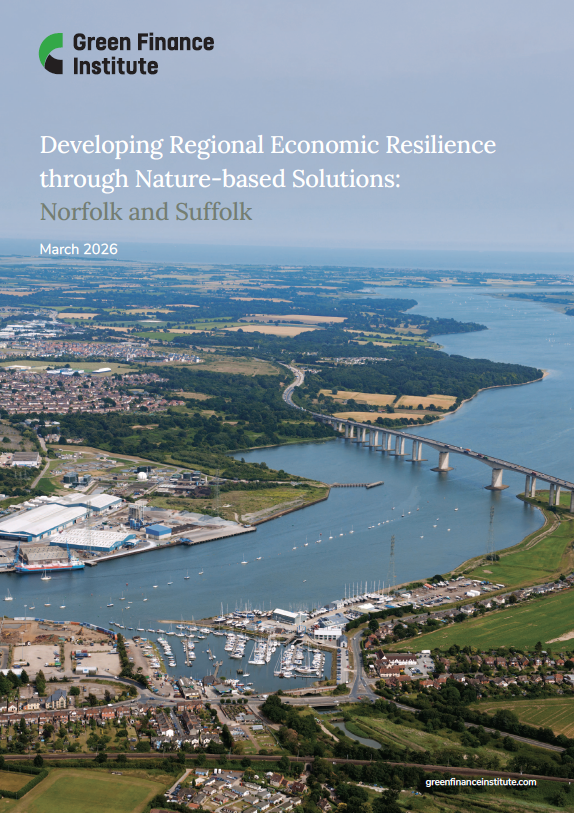
Developing Regional Economic Resilience through Nature-based Solutions: Norfolk and Suffolk
Continued nature degradation is wiping billions of pounds off the UK economy every year. Estimates show that impacts in the UK from climate change...
Hive
Insights
25.04.24 8 min read
Assessing the Materiality of Nature-Related Financial Risks for the UK
Nature degradation could cause a 12% loss to UK GDP. A first-of-its-kind analysis quantifies the impact that nature degradation, both domestically and internationally, could...
01.08.25
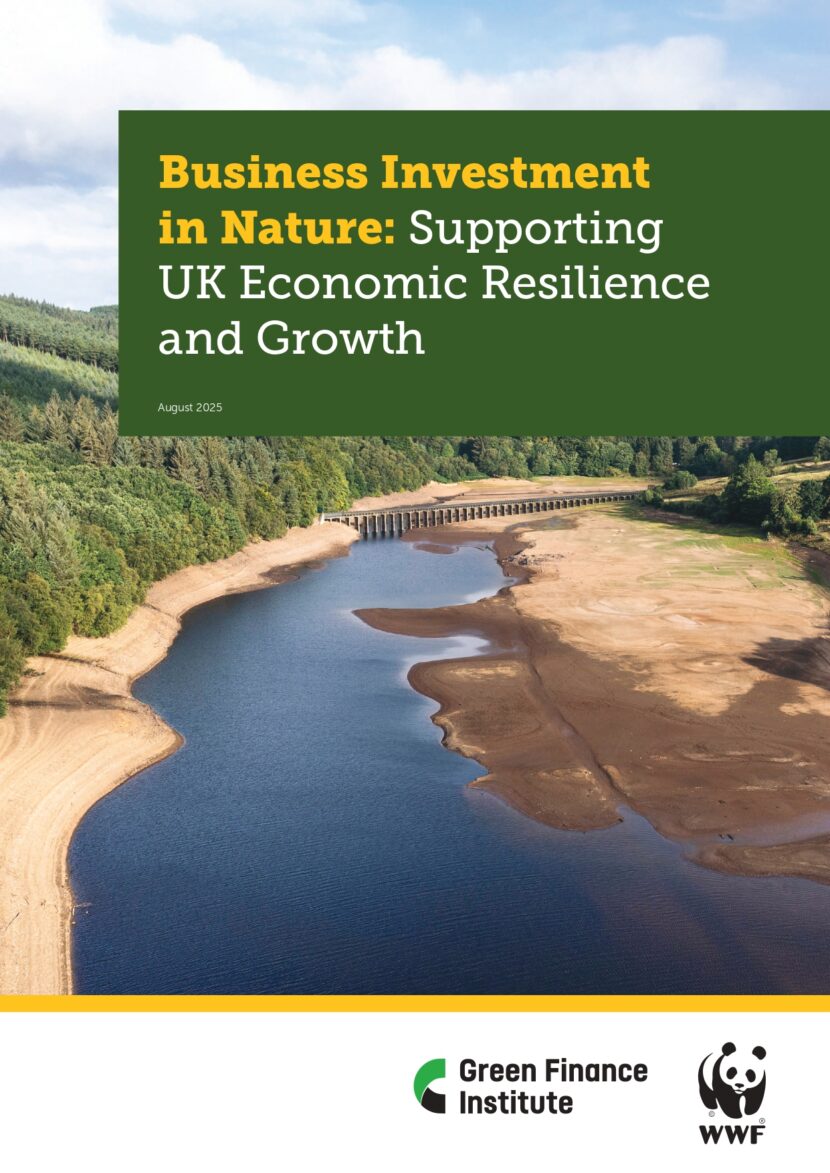
Business Investment in Nature: Supporting UK Economic Resilience and Growth
The GFI and WWF-UK are working closely with business, finance and academia to develop Nature-Positive Transition Pathways (NPPs) for the UK economy. This paper...
