











GFI’s CDR Catalyst launches, unlocking £1m in financing in first-of-its-kind British biochar deal
by | May 13, 2026

- Oxbury Bank commits to £1m in financing, working with Restord to scale carbon dioxide removal in Cornwall as the first deal facilitated through the Catalyst.
- The Catalyst will support commercial‑scale adoption across the UK, where more than 100 project developers currently account for less than one percent of global carbon removal credits.
London, UK, 13 May 2026 – The Green Finance Institute’s Carbon Dioxide Removal Catalyst (CDR Catalyst) launches today, introducing a new approach to unlocking finance for the UK’s fledgling carbon removal sector. The Catalyst has helped secure a £1m financing agreement from Oxbury Bank, supporting Cornwall-based biochar developer Restord, in a first of its kind carbon dioxide removal deal.
Enabled by philanthropic capital to derisk the project from Catalyst founding partner, Terraset, the deal represents the first commercial loan to support a UK based biochar company. Designed to close the commercialisation gap to scale the UK carbon removal sector, the deal was delivered through the CDR Catalyst.
The Catalyst is announced following the Climate Change Committee’s publication of its cost analysis of the 7th Carbon Budget which identified the emerging investment opportunity in engineered carbon removals, highlighting “designing of finance mechanisms that unlock private capital at scale necessary for the transition.”
“Greenhouse gas removals will play a key role in reaching our climate targets, supporting sectors from aviation to agriculture in offsetting their emissions,” said Energy Minister Michael Shanks.“The Green Finance Institute’s catalyst has the potential to unlock carbon dioxide removal across the country – creating jobs and delivering investment for communities, which its first project in Cornwall is already doing.”
Unlocking finance for early commercial CDR
The Restord deal combines a forward purchase of carbon credits from Terraset, alongside a new partnership structure between Restord, The Green Waste Company and Woodtek Engineering, who will provide the pyrolyser technology to produce the biochar – with Oxbury extending the required loan financing to support the project.
“This deal is an exemplary model for how financial innovation can support CDR projects to reach commercialisation,” said Tom Previte, founder and CEO of Restord. “This financing enables Restord to remove circa 2,000 of tonnes of CO2 each year through the production of high-quality biochar, a CDR method that sequesters carbon from organic matter.”
“This is an important step for carbon‑removal projects in the UK, and we’re really pleased to be supporting Restord with this first‑of‑its‑kind loan. The CDR Catalyst from the Green Finance Institute helped give us the confidence and information we needed to move quickly and back this new area of investment. As the UK’s only bank focused on the rural economy, we can see how high‑quality carbon‑removal projects can both help the environment and create new opportunities for rural businesses,” said Nick Evans, co-founder and Managing Director of Oxbury.
The Catalyst was designed by GFI after recent analysis of the UK CDR sector identified the need for projects to move from grant-dependence to bankable, revenue-generating operations. The initiative provides hands-on commercial and financial expertise and will leverage catalytic philanthropic capital to unlock financing where appropriate.
“The UK has outstanding CDR innovation, but scaling projects is very challenging, and too much of it is stuck between the lab and the market,” said Georgia Berry, CDR Director at the Green Finance Institute. “This first-of-a-kind deal with Oxbury provides a strong proof point for our approach to scale the UK’s CDR market through convening critical partners, accessing patient capital and structuring deals in a way that de-risks investment.”
“Terraset exists to use philanthropic capital where it can have the greatest catalytic effect, and the UK’s carbon removal sector is at precisely that stage,” said Adam Fraser, Chief Executive at Terraset. “We are partnering with the GFI to support early commercial projects, like Restord, to increase the impact of our capital through risk sharing needed to unlock private capital from trailblazing institutions like Oxbury.”
The CDR commercialisation gap
Despite over 100 UK developers of CDR projects, the UK supplies less than one percent of global credits, with most projects hindered by high capital costs, technology scale risk, and a lack of early revenue certainty.
This commercial bottleneck exists despite strengthening investor interest and government policy signals, including the development of Carbon Contracts for Difference and plans to integrate CDR into the UK Emissions Trading Scheme by 2029. Without dedicated early-stage support for projects to help bridge this commercialisation gap, through interventions such as access to grant funding, loan guarantees, philanthropic capital, and the structuring of projects to spread risk, the UK could fall short of targets set by the Carbon Budget Delivery plan to deliver 21.8MtCO2 of engineered removals by 2035.
To date, UK engineered CDR projects have largely relied on grant funding or venture capital investment. As these sources become increasingly constrained, diversifying the financing landscape is essential to familiarise a broader set of investors with carbon removal for scale. The CDR Catalyst is designed to intervene precisely at this friction point, with today’s announcement a blueprint for future deals.
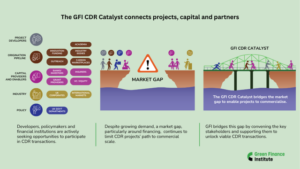
Addressing the friction point through collaborative support
GFI and Terraset will continue to work with growth stage developers, like Restord Biochar, through the CDR Catalyst to help derisk early commercial projects in biochar, direct air capture, bioenergy carbon capture, enhanced rock weathering, and carbon storage in building materials.
Terraset will contribute philanthropic capital to help derisk early commercial projects, building on its experience cementing more than two dozen carbon removal pre-purchase agreements around the world, and deploying other innovative uses of finance, such as equity stakes or first loss guarantees on a loan, that can anchor investor confidence.
Milkywire, an experienced supporter of innovative carbon dioxide removal partners, will be a strategic advisor to the Catalyst. Its Climate Transformation Fund will operate as a source of growth stage projects for the Catalyst, with both Milkywire and the Climate Transformation Fund contributing ongoing insights into market dynamics and project performance.
“Milkywire’s Climate Transformation Fund supports pioneering projects at the innovation frontier, but these solutions need a clear path into commercial reality,” said Robert Höglund, Head of Climate Strategy & CDR at Milkywire. “Partnering with GFI through the CDR Catalyst helps us build that pipeline by supporting early-stage ideas that can mature into investment-ready projects.”
Alongside direct support, the Catalyst will generate evidence on real-world delivery barriers and feed insights back to UK government to improve the enabling environment for high integrity CDR.
Related content

Insights
09.07.25
A critical moment for CDR
To date, the engineered CDR sector has largely been driven by quasi-philanthropic pre-purchases of CDR credits in the voluntary carbon market, but governments are...
23.07.25
The Role of Carbon Markets in Financing Carbon Dioxide Removal
The role of carbon markets in financing carbon dioxide removal: An introduction for buyers and financiers' presents a summary of the latest activity in...
01.05.25
The Investment Readiness of Carbon Dioxide Removals in the UK – A Preliminary Assessment