







Quito Water Fund
Quito Water Fund
| Title | Quito Water Fund |
| Country/Location | Ecuador, Latin America |
| Investment to Date | USD 22.5 million |
| Revenue Model | Water Fund |
| Private Investment/Finance Structure | Contributions provided by a mix of private sector companies |
| Public/Philanthropic Investment | Environmental surcharge on water bills allocated by the public water utility. Contributions provided by NGOs and international donors |
| Env/Social Impact | Improved Water Quality, increased water availability, biodiversity uplift and improved soil health |
Summary
Quito, Ecuador’s Water Fund, Fondo de Protección del Agua (FONAG), was the world’s first water fund, established in 2000 through a 1% environmental surcharge on water bills by the city’s water utility, EPMAPS. The fund’s revenue is used to protect and restore the páramo ecosystems, which supply water to Quito’s 2.7 million residents. FONAG invests in a range of NbS such as forest restoration, sustainable agriculture, erosion control, and community education to enhance water security. The fund supports over 28,000 hectares of watershed conservation efforts, benefiting more than 3,500 farming families and balancing ecosystem restoration with local economic needs. Over time, FONAG’s funding has increased, reaching 2% of water tariffs, providing a long-term financial source to safeguard Quito’s water supply. The project has demonstrated how public money can be effectively used to crowd in private capital into nature-based water conservation activities and that effective monitoring and community engagement are key to the success and replicability of the scheme.
Introduction
The high-altitude city of Quito relies on the surrounding páramo ecosystems of tropical grasslands to supply water for its 2.7 million inhabitants. In the 1990s, these ecosystems were under increasing threat from deforestation, agriculture, and urbanisation.
In 2000, the city’s water utility company, Empresa Pública Metropolitana de Agua Potable y Saneamiento (EPMAPS), implemented a reform to the city’s water tariff system, introducing a 1% charge on water bills, specifically earmarked for environmental protection. [1] The additional charge was allocated to a newly established fund: Fondo de Protección del Agua (FONAG), the first water fund in the world.
FONAG operates as a trust fund dedicated to the conservation and restoration of Quito’s watersheds. In addition to the surcharge on water bills, it receives contributions from private companies who rely heavily on the city’s surrounding watershed, including breweries, bottled water companies and the electricity sector. The fund is structured as a private mercantile trust, using the yields of its equity to finance conservation projects to protect and restore the watersheds.[2] The fund’s board includes representatives from public and private sectors, as well as civil society.
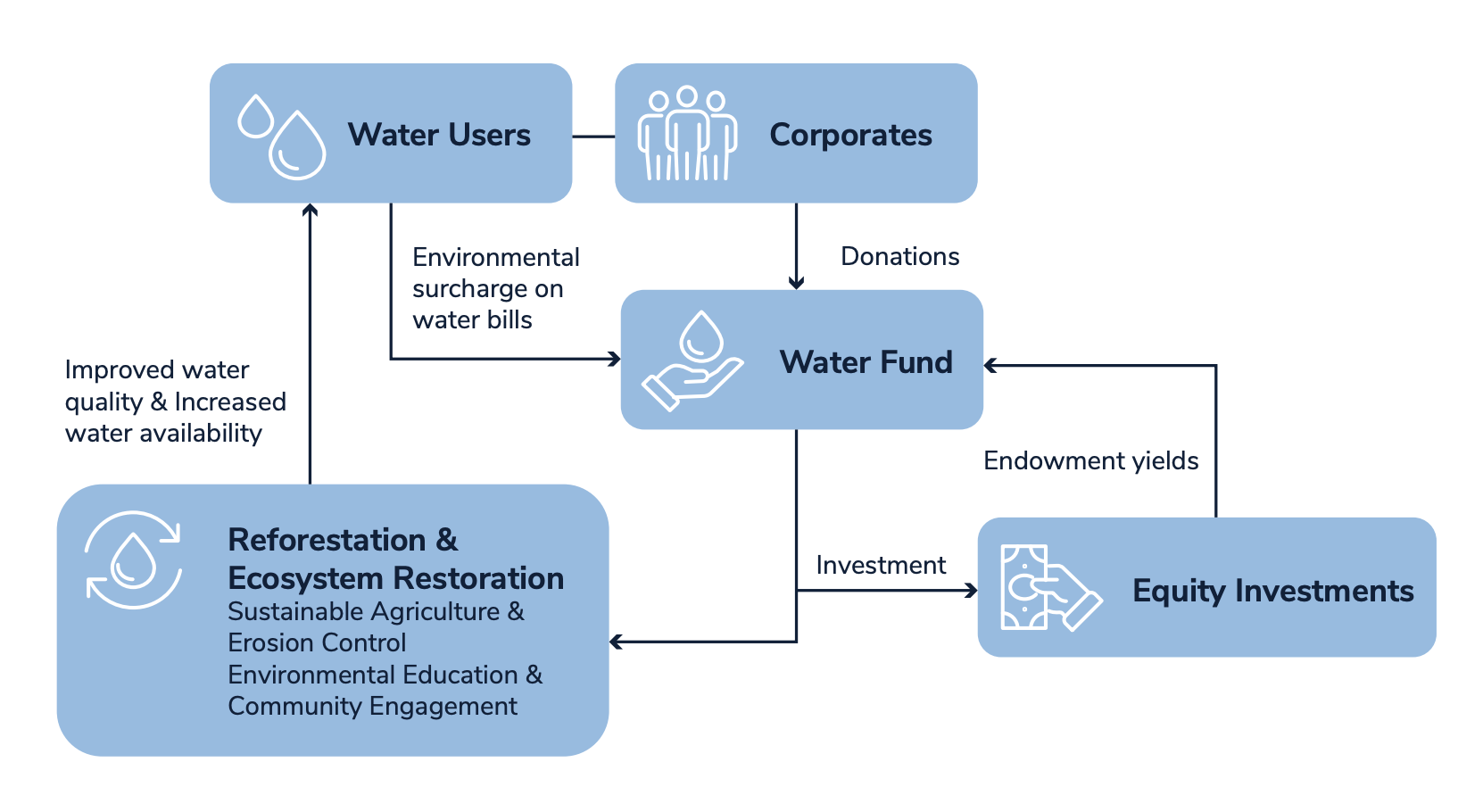 Figure 1: FONAG Structure
Interventions
The Fund invests in a wide range of NbS aimed at preserving and improving the health of Quito’s watersheds, both in lands owned by the utility and by engaging with private landowners. The Fund manages about 20,000 hectares of its own lands where park rangers are posted to conduct restoration activities. [3] In privately-owned lands, the Fund developed conservation agreements which could include support for sustainable productive activities. In utility or Fund-owned land, the land is used only as a source of water with no productive activity.
Reforestation and Ecosystem Restoration: FONAG invests in the restoration of degraded lands in the páramos. This includes planting native tree species, restoring riparian zones, and creating wetlands. [4] These efforts improve water infiltration, reduce soil erosion, and enhance biodiversity. Through the Fund’s Vegetation Cover Recovery Program (PRCV), native tree species like the Polylepis tree are planted to increase overall vegetation cover and improve water filtration. [5] Healthy forest and riparian zones serve as natural buffers that reduce sedimentation and erosion, allowing rainwater to be absorbed gradually, which recharges aquifers and helps ensure a stable water supply for downstream areas. FONAG also funds the creation and restoration of wetlands which act as natural water reservoirs and filters. Restored wetlands enhance the páramo’s ability to retain water during rainy periods and release it slowly during dry seasons, contributing to year-round water availability.
Sustainable Agriculture & Erosion Control: FONAG works with local farmers to promote agroecological practices that minimise the sector’s impact on water resources, improve the water holding capacity of soils and reduce erosion. This includes training in agroforestry and sustainable livestock management and the implementation of erosion control measures such as terracing and contour plowing. Through these programs, FONAG has provided training and technical assistance to over 3,500 farming families, improving agricultural productivity while mitigating environmental degradation. [6]
Environmental Education and Community Engagement: FONAG has a strong focus on environmental education and raising awareness among local communities about the importance of watershed conservation. The fund supports environmental education programs for members of the water sector, community workshops, and participatory planning processes that involve residents in decision-making and conservation activities.
Initially, the focus was on primary school children, using diverse educational approaches such as school visits to the Cachaco Ecological Park, visits to rural schools and creating camping experiences for urban schoolchildren. These interventions aimed to foster emotional connections to nature, combined with value-based education and experiential learning. Each child was appointed as a “Water Guardian” to instill a sense of responsibility for protecting water resources. [7]
Other initiatives introduced community members and educators to the critical role of watersheds through guided tours and workshops. Using a combination of experiential learning, popular education, and emotional engagement, the program has evolved to address the specific needs of different stakeholders.
Water Quality Monitoring and Research: FONAG invests in monitoring and research initiatives to assess the health of the watersheds and the effectiveness of conservation measures. The data collected helps inform future interventions and helps to quantify the return on investment of conservation measures. [8]
The Monitoring and Surveillance of Protected Areas program started in 2004 with monitoring activities focused on both water quantity and quality to evaluate the impact of interventions and ensure that ecosystems storing and regulating water resources remain in a healthy state. [9] Water quantity monitoring is focused on understanding the regulation of water flow within ecosystems, detecting variations that might indicate issues, while water quality monitoring analyses physical-chemical characteristics to ensure compliance with standards for human consumption.
Status of the Fund
Although the original agreement for EPMAPS to add an environmental charge to water bills was done at their own behest, in 2007 the Metropolitan Ordinance No.199 and No. 213 ratified the 1% contribution to conservation into law and set out that this would increase by 0.25% annually until it reached 2%, where it stands today. [11] This created a long-term source of revenue for the Fund. The Fund has so far leveraged USD 22.5 million, benefiting over 3,500 farming families and implementing NbS across over 28,000 ha. Comparative studies have found that in areas managed by FONAG, suspended solids are significantly lower (from 4 – 11 mg/l) than areas not managed by the Fund (6 – 70 mg/l). From the perspective of the water utility, UNEP found that for each dollar invested in the Fund for conservation activities, EPMAPS saved USD 2.15 over 20 years of the Fund’s operation. [12]
Replicability & Scalability
FONAG’s success as the world’s first water fund demonstrates the replicability of this model for addressing watershed conservation in urban areas dependent on natural ecosystems for their water supply. The Fund’s design ensures a steady source of revenue to pursue watershed conservation, environmental education and monitoring. By embedding conservation funding into a public utility system, this approach offers a sustainable financial solution that other cities can adopt. The Fund has already inspired similar initiatives globally, particularly in Latin America, where cities like Bogotá, Lima, and São Paulo have developed water funds modelled after FONAG’s success.
FONAG successfully navigated designing interventions for multiple land ownership contexts. While lands owned by the utility are reserved solely for water production, private landowners are engaged through conservation agreements that incorporate sustainable productive activities like agroforestry, allowing them to generate income while protecting critical water resources. This adaptability makes the FONAG model suitable for various land-use contexts, balancing economic needs with conservation goals.
The Fund’s engagement with multiple stakeholders through its educational activities complemented the direct NbS interventions by creating a sense of shared ownership and shared responsibility for the watershed.
FONAG’s focus on monitoring and demonstrating the cost-effectiveness of NbS ensures that the interventions are evidence-based and can attract future investment. The success of the Monitoring and Surveillance of Protected Areas program in showing tangible improvements in water quality and ecosystem health highlights the importance of collecting and sharing data to measure the return on investment. This data-driven approach is crucial in securing ongoing funding and expanding the model to other regions.
Lessons Learned
- Monitoring impact of NbS for water is key to demonstrate cost-effectiveness and attract additional investment.
- The economic and social needs of local communities need to be balanced with conservation. In the case of FONAG, interventions proposed on utility-owned land differed from those implemented on privately-owned land, with private owners supported to adopt sustainable productive activities such as agroforestry which would provide income while protecting and restoring the watershed.
- The Quito Water Fund illustrates how a water-based revenue model can be designed at the city level, as in this case the mayor’s support was central to the launch of the Fund, illustrating the diversity of public governance levels that water-based revenues can relate to (e.g. State level for the Reef Credits scheme in Australia, Federal/National level for England’s Nutrient Neutrality Scheme).
- Setting an independent financial manager for the Quito water fund ensured that conflicts of interest of the various stakeholder groups financing and impacted by the Fund are adequately managed. This is a key aspect of the success of water funds.
- Water Funds such as this one enable the implementation of localised interventions for improved water quality from passive interventions (e.g. the elimination of invasive species) to active restoration strategies (e.g. restoring native paramo vegetation and wetland habitat).
- For countries implementing water funds in context of socio-economic uncertainty, the Quito Water Fund demonstrates the importance of long-term public support for the mechanism which enabled this Water Fund to overcome the macroeconomic crisis faced by Ecuador since 1998. In Sri Lanka for example, a similar scheme is going through a re-launch due to private sector companies withdrawing their contributions when the country suffered from a severe macroeconomic crisis.
Updated as of October 2025
Sources:
[1] TNC Resilient Watersheds (2020). The story of Quito – the first “water fund”
[2] Lorena (2019). The Path of Water – FONAG: work and lessons
[3] Ibid
[4] Latin American Water Funds. Fund for the Protection of Water (FONAG)
[5] ProAmazonia. FONAG: a benchmark in the ecological restoration of water source ecosystems
[6] Lorena (2019). The Path of Water – FONAG: work and lessons
[7] Ibid
[8] Ibid
[9] Ibid
[10] Ibid
[11] Lorena (2019). The Path of Water – FONAG: work and lessons
[12] UNEP (2021). In Ecuador, an innovative financing tool secures water supplies
Case study from Revenues for Nature Guidebook Series: Nature-based Models for Unlocking Private Investment into Freshwater (Expanded Edition)
