












The High Integrity Forest Investment (HIFOR) Initiative
The High Integrity Forest Investment (HIFOR) Initiative
| Title | The High Integrity Forest Investment (HIFOR) Initiative |
| Country/Location | Global tropics – pilots in Brazil, Republic of Congo and Colombia |
| Investment to Date | Undisclosed |
| Revenue Model | Payment for Ecosystem Service (PES) |
| Private Investment/Finance Structure | Private sector purchase HIFOR units; 5-year outcome bond |
| Public/Philanthropic Investment | Grants from Bank of America and others for project development |
| Env/Social Impact | Rainforest conservation, improved biodiversity, improved livelihood |
Summary
The Wildlife Conservation Society (WCS) launched the High Integrity Forest Investment (HIFOR) Initiative to channel long-term conservation finance to the stewards of high integrity tropical forests. At the core of the Initiative is the HIFOR standard and methodology, developed by WCS to measure ecological integrity and management effectiveness. Each HIFOR unit represents one hectare of well-maintained, high integrity tropical forest. Public and private sector actors, including financial institutions and corporations, can purchase these units to make contributory claims, such as supporting climate regulation or strengthening the resilience of their value chains. Pilot projects are currently underway in the Brazilian Amazon, the Congo Basin, and Colombia. To strengthen its appeal to private investors, HIFOR is also developing an outcome bond, designed to provide upfront financing for projects, with HIFOR units serving as a KPI.
Large intact tropical forests are essential for the planet’s health. They provide a range of climate, biodiversity and socio-economic benefits including supporting the livelihoods of Indigenous and local communities. These ecosystems play a critical role in climate regulation, stabilizing rainfall patterns, preventing soil erosion and supporting biodiversity.
Despite their value, there are currently no robust, dedicated financial mechanisms to specifically protect intact forest landscapes, and existing markets rarely prioritise their unique ecological importance. Safeguarding intact forests requires significant amounts of funding, but assigning and monetizing their value remains a challenge.
The HIFOR Initiative has been designed to address this financing gap. It provides long-term conservation financing to high integrity tropical forests through the sale of HIFOR units. By utilizing a metric to quantify ecological integrity, the HIFOR Initiative enables funding and investment to flow toward the long-term protection of these ecosystems.
Overview of the model
Through the sale of HIFOR units, the HIFOR Initiative is a payment for ecosystem services model that incentivizes the protection of ecosystems which are in good ecological condition and are not under immediate threat.
One HIFOR unit represents a hectare of well-conserved, high integrity tropical forest. [1]
‘Well-conserved’ can be defined as high ecological integrity maintained over a decade of monitoring, while ‘ecological integrity’ is measured using the Forest Landscape Integrity Index (FLII), a universal metric developed by researchers convened by WCS to understand the level of threats to a forest and how intact they still are [2]. Using various data sources including satellite imagery, the FLII measures ecological integrity by evaluating the drivers of forest degradation, taking into account forest cover and land use change caused by human disturbance. Using the FLII methodology, the HIFOR Initiative classifies an area as being of high ecological integrity if it has a score FLII score of ≥9.6.
HIFOR units represent both climate and biodiversity benefits:
- Biodiversity benefits are associated with each hectare of forest that remains in excellent ecological condition
- Climate regulation benefits are number of tons of net CO2 removals from forest biomass growth
The HIFOR unit also represents other ecosystem services including:
- A “biophysical cooling” effect (separate from CO2 absorption) that adds an extra 50% to its cooling value
- Social benefits
The HIFOR Initiative was launched and developed in 2021 by WCS, a US-based not-for-profit. WCS is responsible for overseeing the Initiative and has developed the standard and the methodology that underpin the unit. Where possible, the HIFOR standard looks to align with global standards and initiatives such as the High-level Principles from WEF, the Biodiversity Credit Alliance (BCA) and the International Advisory Panel on Biodiversity Credits (IAPB). For example, HIFOR aligns with requirements for transparent registries, third-party audits, community participation, free prior and informed consent, use of grievance redress mechanisms, and consideration of environmental impacts.
The HIFOR Initiative is in pilot phase, with WCS currently acting as global administrator and technical support to the initial pilot projects. However, as the standard is developed, WCS will look to transfer administration of the standard to an external standards body, and focus more fully on supporting project development.
Generation of HIFOR units
The following steps outline the process that a Project Proponent follows to generate, issue and sell HIFOR units.
Figure 1:
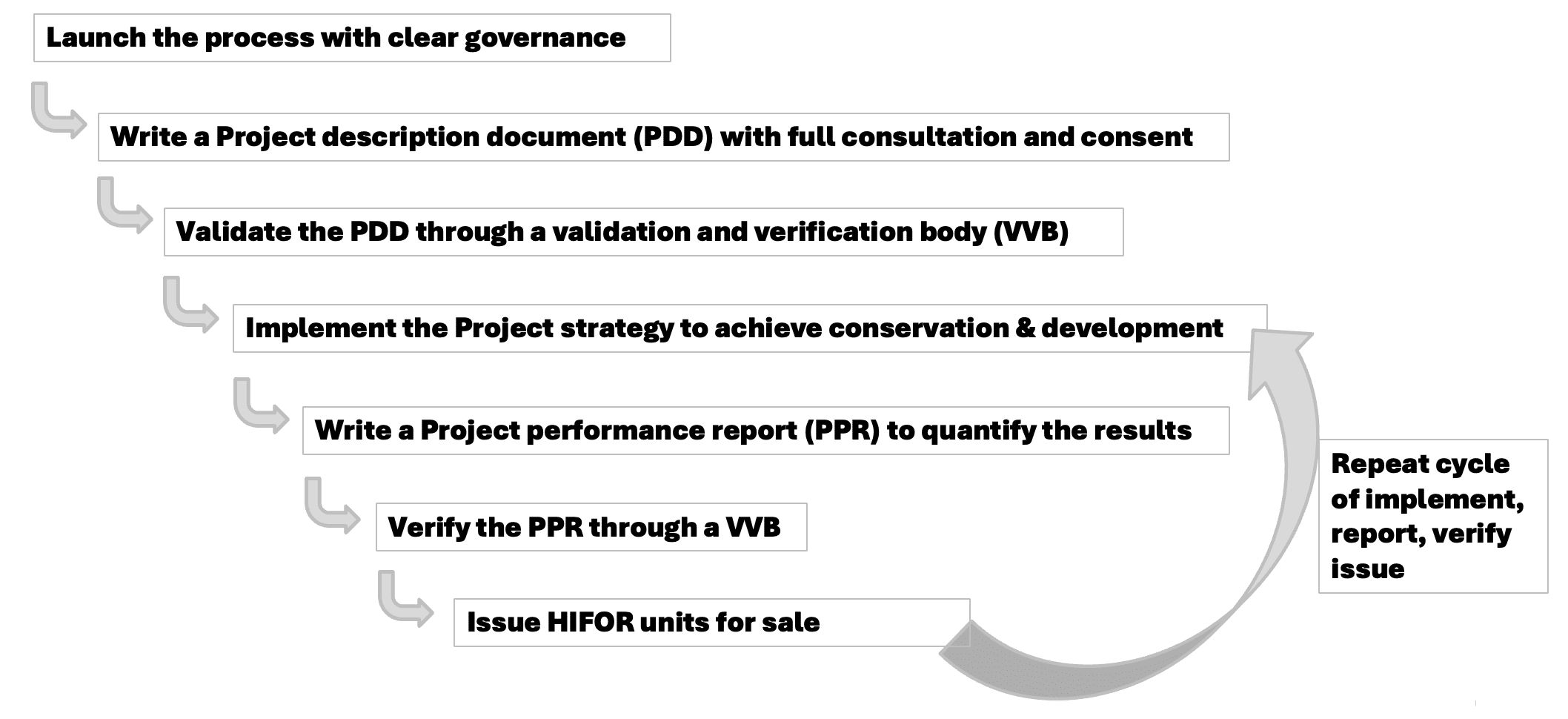
Source: HIFOR (2025)
There is currently one methodology to generate HIFOR units [3]. HIFOR units are issued based on ecological integrity and the maintenance of tropical forests within a HIFOR management, area rather than performance in relation to a baseline trend in degradation. As such, HIFOR units are not designed to meet strict additionality requirements but rather the projects act as preventive care for these ecosystems. Projects will meet the additionality test for projects in the ‘maintenance’ category as set out by the High Level Principles mentioned above.
The model is currently in its pilot phase, with a small number of pilot projects that all involve WCS providing technical support to the project owners. As it scales, however, any project developer will be able to work with landholders and local communities to develop projects using the HIFOR standard and methodology. There are currently three projects piloting HIFOR across Latin America and Africa.
Once outcomes are independently verified by a third-party auditor, HIFOR units can be generated and sold to anyone seeking to support contributory claims, such as governments, corporations and ESG investors, or wishing to invest in the ecological resilience of their value chains.
WCS is currently developing a public registry where all HIFOR projects, credit issuances, transfers and retirements will be logged and published to maintain transparency.
An example of a HIFOR pilot project
Projects must run for a minimum of 30 years and cover a minimum area of 100,000 hectares. One of the HIFOR projects is in and around Jaú National Park (JNP) in Brazil which covers 2.3 million hectares of tropical forest and is the largest National Park in the Amazon. The park is owned by the Ministry of Environment and the Afro-descendent quilombo communities, which comprise approximately 1,000 quilombo people [4].
For this project, philanthropic funding was initially provided by Bank of America to develop the pilot and carry out stakeholder engagement and capacity building. The project is being co-developed by the government (through the Chico Mendes Institute, ICMBio, the government agency responsible for conservation) and quilombo communities, and the project is being implemented by multiple organisations including WCS, the national government, and quilombo communities.
ICMBio and the communities will together decide how project revenues will be used on the ground. While activities are still to be decided, proposed investments include eco-tourism, fisheries and sustainable development such as improved sanitation and solar. Regardless of the specific activities implemented, the main goal of the project is to maintain the ecological integrity of the landscape and support the livelihoods of the local communities.
The project is designed to directly benefit local communities by providing a sustainable revenue stream in return for their role as stewards of the forest. At the end of each monitoring cycle, the project proponent will own the HIFOR units and will be able to sell those to support further conservation and sustainable development work.
Demand
The business case for HIFOR is currently being refined. HIFOR units will be able to be purchased by anyone who intends to support contributory claims such as climate regulation and biodiversity conservation. It is expected that demand for the units will come from a range of sectors including the insurance, banking investment and pharmaceuticals sectors and those that have supply chains dependent on the HIFOR areas such as timber, agriculture and hydropower. Buyers can report their purchases of HIFOR units under several reporting frameworks such as SBTI, CSRD ,and TNFD. These purchases are considered additional to regulatory obligations or voluntary climate commitments. HIFOR units cannot be used to support compensatory claims, such as offsetting and net zero pledges.
While the model was initially developed with a primary focus on carbon, demand was limited due to the availability of more established carbon credit markets. Recognizing the broader value of intact tropical forests, the Initiative pivoted and is focusing on offering multiple benefits. However, this is not without its challenges and current efforts are centred on strengthening and communicating the science behind HIFOR’s contribution to ecological integrity. More work is still needed to raise awareness and educate investors on the full range of benefits that HIFOR units can offer beyond carbon mitigation.
Investment Structure: Financing HIFOR Projects
While the market is still being developed, WCS is exploring alternative financial mechanisms to scale the model, including the issuance of an outcome bond to raise capital. This will unlock upfront financing for conservation and implement the projects at pace. For the Brazil project, WCS has identified a multilateral bank to issue a five-year outcome bond.
The exact structure of the outcome bond is still to be decided. One option is to structure the bond in a similar way to the Rhino Bond, where investors forgo their coupon payments and these are invested into the HIFOR project. HIFOR units would be used as a KPI, tied to ecological integrity, and if the KPI was met, an outcome payor would provide a success payment, higher than the total value of foregone coupons. At the bond’s maturity, HIFOR units could be generated and would be owned by the project proponents. These can then be sold to the public and private sector creating an additional revenue stream for the project proponent, including local communities.
Alternatively, the bond could be structured in a similar way to the Amazon Reforestation-Linked Outcome Bond, where investors’ returns are linked to the generation of HIFOR units and corporates purchase the units through offtake agreements. This model would increase demand for HIFOR units while removing the need for an outcome payor.
Measurement, Monitoring and Verification
Project outcomes are measured on a ten-year cycle, complemented by annual monitoring of project activities, across the following key areas:
- Ecological integrity
- Carbon absorption – total net CO2 removals
- Socio-economic benefits
HIFOR delivers significant benefits for biodiversity, with the extent of high integrity forest (which is highly biodiverse) used a proxy that can be readily compared across sites. To complement this, individual projects can track more specific biodiversity outcomes to improve their attractiveness to the market, and this is being explored in the pilots. Proposed biodiversity metrics will be focused on the abundance of selected flagship species, tailored to each project and geography. For example, in Brazil the tracked species is a large river turtle, while in Congo, elephant and gorilla populations are likely to be used as a key metric.
Challenges
A key challenge for the HIFOR Initiative is the lack of an existing market framework. HIFOR functions as a type of preventive care for tropical forests, sitting alongside mechanisms such as REDD+ which prevents active deforestation and ARR which restores degraded landed. However, ecosystems that are already in good condition often fall outside traditional carbon markets because they don’t meet the additionality requirements that many carbon finance mechanisms require. Despite their ecological importance, they are currently assigned no financial value, which makes it difficult to create a market and attract private sector investment. By using a universal metric to measure ecological integrity and bundling together multiple benefits into one unit, the HIFOR Initiative can demonstrate quantifiable benefits and impact which can attract private sector investment to grow the market. The next few years are therefore critical for educating investors and raising awareness to build confidence in this emerging market and unlock the support needed to scale HIFOR’s impact.
In the early stages of building this market, innovative financial mechanisms like outcome bonds offer potential to mobilize capital but are complex to structure and still require substantial upfront funding to be viable, in addition to the need to secure an outcome payor. However, HIFOR units could be purchased through offtake agreements which would remove the need for this type of funding.
Scaling and Replicating
While the HIFOR Initiative is still in pilot phase it serves as a potential model for outcome-based conservation finance for intact tropical forests. By generating units, the HIFOR Initiative offers a scalable model that combines large scale conservation efforts with sustainable revenue generation. Intact tropical forests cover around 750 million hectares across Latin America, the Congo Basin and Southeast Asia, presenting an opportunity to scale across multiple geographies. The HIFOR Initiative could also be replicated to other ecosystems such as peatlands with the development of complementary methodologies based on ecological integrity metrics appropriate to those ecosystems.
However, successful scaling and replication depends on several factors. A key focus for the next year is securing upfront funding for the Brazilian project through the issuance of an outcome bond.
Expanding the methodology and moving the standard to an external body is critical for scaling HIFOR. Management through an independent external organization will help ensure alignment with international standards and encourage new project developers to adopt and implement projects aligned with the HIFOR methodology.
Additionally, WCS is focusing on expanding the methodology to include science-backed metrics such as rainfall production. Intact forests such as the Amazon, play a critical role in regulating rainfall and water security, essential for companies whose operations and supply chains depend on climate stability. The successful scaling of this model will be dependent on the development of a thorough scientific understanding of ecosystem services in the specific region and demonstrating to companies the long-term economic benefits. For example, demonstrating to the agricultural and hydropower sectors the benefits of rainfall production on climate stability, can increase demand for HIFOR units but also link buyers to their supply chains to build supply chain resilience.
Lessons Learned
- Using consistent and globally recognized metrics is essential for ensuring consistency and scalability in PES schemes. This approach provides comparability of units generated across different regions and makes complex ecological information more simple, transparent, and understandable for buyers and stakeholders.
- Catalyzing investment through innovative financial mechanisms, such as outcome bonds, can play a central role in the start-up phase of a model. It can support model development by de-risking investment and providing needed upfront capital, while providing more time for private sector demand to emerge.
Updated as of October 2025
Interview with Ashley Camhi, Director of Innovative Finance, Forests and Climate Change, Wildlife Conservation Society
[1] Forest Landscape Integrity
[2] HIFOR (2024) Methodology for HIFOR units
[3] Ibid.
[4] HIFOR (2025) Jaú National Park
