









Everyone Agrees We Need More Resilient Supply Chains: Is A Lack of Internal Budget Holding Companies Back?
Summary
- Climate and nature-related disruptions are creating material costs for businesses, driving resilience rapidly up the corporate agenda.
- Most businesses cite limited internal budgets as the main barrier to action, yet new funding and partnership models are emerging to overcome this challenge.
- The constraint is rarely capital alone. Business leaders should be asking: “Who else benefits from solving this challenge, and how can we align capital, incentives and delivery around a shared resilience outcome?”
- Organisations that test new funding models, prove value and build delivery capability today can become tomorrow’s leaders in resilient supply chains.
Heatwaves in Europe this summer alone cost more than €50bn in lost economic output

As climate and nature risks intensify, resilience is rapidly climbing corporate agendas. A recent Capgemini survey found that 76% of executives expect investment in climate adaptation to increase over the next year.[1]
The intent is there. Yet progress remains slow.
With business leaders, the challenge is rarely a lack of awareness. Instead, many are grappling with a more difficult question:
How can we most effectively deploy our capital to build resilience at the scale required?
The funding problem may be the wrong diagnosis
When businesses hold off on action, one explanation comes up repeatedly: there simply is not enough internal budget to tackle the challenges at hand. But focusing on budget constraints alone can miss the real challenge.
When a water-stressed region faces shortages, when flooding disrupts logistics networks, or when ecosystem degradation threatens agricultural productivity, these impacts are rarely confined to a single organisation. The costs cascade across several supply chains.
Yet despite these shared risks, businesses continue to approach resilience through isolated budgets, using investment models designed for a different era of sustainability.
In this new paradigm of shared resilience challenges, it may be time to rethink the funding models we’ve historically relied upon.
The question is no longer simply whether one organisation can afford to invest. It is how multiple beneficiaries can align capital, incentives and delivery around a shared resilience outcome.
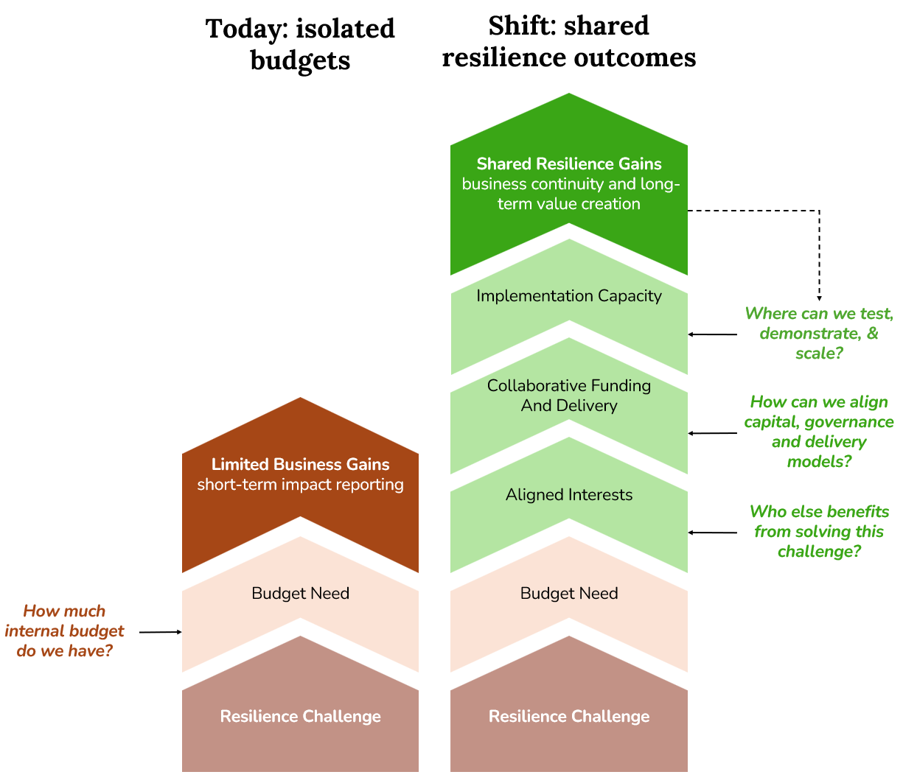
As a result, some organisations are exploring approaches that increase the impact of every pound invested, including blended finance, partnerships with banks to support low-cost lending and cost-sharing arrangements between businesses sharing the same landscape or supply shed.
These models are often described as innovative, but their value rarely comes from any financial novelty
More often, success depends on tailoring a funding mechanism to an organisation’s specific commercial challenge, operating model or stakeholder landscape.
When organisations first explore alternative funding models, two common challenges emerge:
- First, many organisations are still building familiarity and confidence with funding approaches that sit outside traditional budgeting and procurement processes. While sustainability teams often see the opportunity first, translating this opportunity into the language of risk, procurement and treasury teams takes time.
 Second, and more substantively, the execution gap is often a significant barrier to successful outcomes, irrespective of the budget available for an initiative. Implementing new funding models within and between large organisations is almost always a complex endeavour, with different objectives, incentives and governance processes.
Funding creates the opportunity for scale, but alignment is what delivers scale.
To build capacity: start small, prove value, then scale
The organisations pulling ahead are rarely those with the biggest budgets. More often, they start with a defined resilience challenge, test a funding model, demonstrate value and build support for wider adoption.
At the GFI, we’ve seen and supported a range of models putting this principle into practice including,
- Corporate coalitions operating within shared sourcing landscapes, such as the Rimba Collective,
- Collective action on logistics corridors, such as Kimberley Clark and Maersk’s freight electrification, and
- Shared cost arrangements with banks on lending arrangements, such as McCain’s regenerative agriculture financing programmes.
We’ll examine more of these emerging approaches, and what others can learn from them, in our next article following COP31.
A different question for business leaders
A lack of internal budget may be the most visible obstacle to investing in resilience, but as these business challenges become increasingly shared, the solutions will need to be shared too.
For business leaders, the question is no longer simply: “How much budget do we have?”
It is: “Who else benefits from solving this challenge, and how can we align capital, incentives and delivery around a shared resilience outcome?”
If you are considering these questions within your business, the GFI Edge team would welcome the opportunity to explore these further with you.
[1] Capgemini Research Institute, A world in balance 2026: The resilience reset (October 2026)
