













Developing Regional Economic Resilience through Nature-based Solutions
Developing Regional Economic Resilience through Nature-based Solutions
Overview
Nature underpins the resilience and security of the UK economy.
UK businesses are highly exposed to risks from climate change and nature degradation, which together erode billions of pounds from the UK economy every year. Across all sectors, impacts such as flooding, wildfire, extreme heat, drought, soil health decline and pollution are driving financial losses through crop failures, operational and supply chain disruption, downtime, reduced productivity, and rising repair and recovery costs.
Nature‑based Solutions (NbS) offer cost‑effective tools that can address multiple risks simultaneously.
Yet despite their potential, existing demand – driven largely by regulation, corporate social responsibility (CSR) objectives, compliance mechanisms such as Biodiversity Net Gain (BNG), and small voluntary carbon and nature markets – remains limited. As a result, NbS lacks the clear, dependable revenue streams needed to support long-term, large-scale delivery and attract investment at scale.
Given the growing exposure of UK businesses to these risks, payments for resilience outcomes offer a logical and scalable new revenue source.
However, creating a stable, predictable source of demand requires building the market infrastructure and regulatory environment that incentivises businesses to meet their resilience needs through NbS.
The Green Finance Institute is working with businesses, government, project developers and market intermediaries across the UK to better understand and address these barriers, helping to scale investment in regional resilience through NbS.
Developing Regional Economic Resilience through NbS: Building Business Demand
This report focuses on the role of businesses as buyers of resilience outcomes and the practical steps that can be taken to unlock payments for resilience outcomes and, in turn, mobilise institutional capital for nature.
The report is structured around three core themes, each examining both the challenges faced by market participants and the opportunities to overcome them, illustrated through case studies from across the UK and Europe:
- Building the business case – enabling businesses to credibly demonstrate the financial benefit from purchasing resilience outcomes from NbS;
- Aggregating demand – building an investable pipeline of projects that have the right conditions to attract business demand for resilience outcomes across multiple sectors; and,
- Aligning regulation – adjusting the regulatory frameworks for highly regulated sectors in line with the practicalities of purchasing resilience outcomes from NbS projects, especially alongside other sectors.
The report also explores the roles of finance and insurance in supporting the scale‑up of resilience payments for NbS, highlighting practical models and use cases to enable investment.
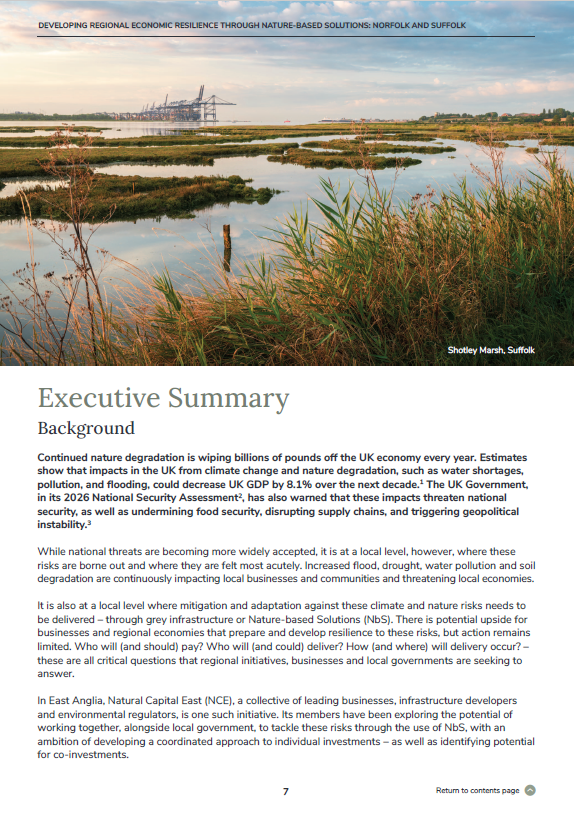
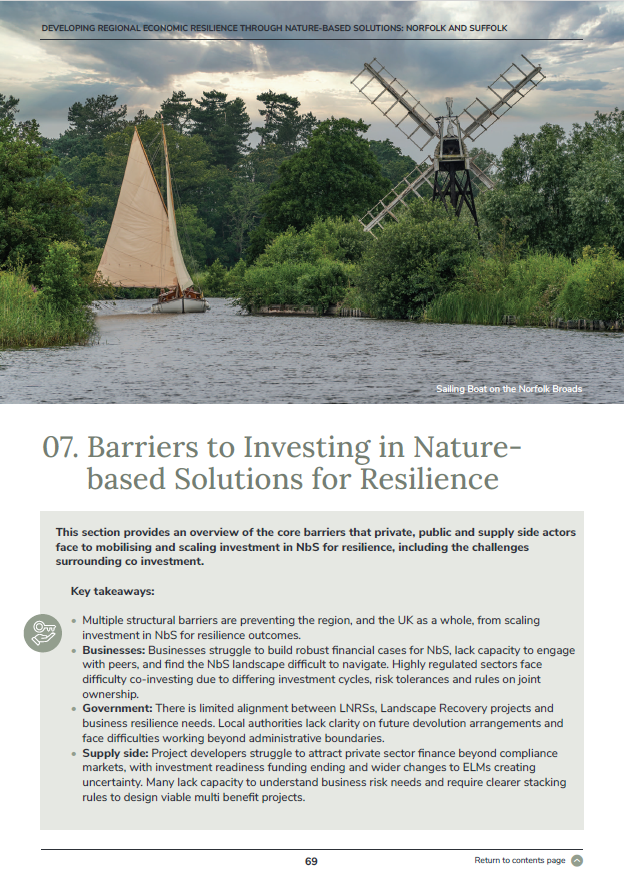
Developing Regional Economic Resilience through NbS: Norfolk and Suffolk
A key precursor to Developing Regional Economic Resilience through NbS: Building Business Demand was the Green Finance Institute’s deep dive into Norfolk and Suffolk. The study provided a first assessment of the region’s exposure to climate and nature-related risks, alongside identifying priority opportunities to help kick-start demand aggregation.
The work was commissioned by and developed in collaboration with Natural Capital East, a coalition of major regional businesses, infrastructure operators and regulators, including Anglian Water, Tarmac, National Grid and National Highways. It explored how regional stakeholders could work together to build demand for resilience outcomes and unlock investment in NbS at scale.
Through this work, GFI engaged with more than 60 stakeholders to understand the key barriers and opportunities relating to investment in NbS across the region. Through extensive engagement with businesses, public sector organisations and supply‑side stakeholders, the work:
- Identified priority locations where local businesses share resilience needs, creating a strong case for co-investment.
- Pinpointed the structural barriers currently preventing investment in NbS.
- Developed practical recommendations that strengthen business cases, build an investable pipeline, and enable scalable, co‑investment models
While anchored in Norfolk and Suffolk, the finding and recommendations have national relevance, offering a clear pathway for regions across the UK to mobilise private investment in NbS and build long‑term resilience.