







From Transactions to Transitions: GFI Indonesia and PT SMI Kick Off Technical Assistance for Indonesia's First Development Trust Fund
Building on earlier work to develop the concept and design of a Development Trust Fund (DTF) model in Indonesia, the Green Finance Institute (GFI) is now providing technical assistance to PT Sarana Multi Infrastruktur (Persero) (PT SMI) to support the implementation of the Trust Fund model as a catalytic mechanism for mobilising private capital into priority climate and infrastructure projects in Indonesia.
Indonesia’s green finance reality is stark: an estimated 85 percent of the financing needed for its climate and energy transition targets remains unmet (Indonesia’s MoF, 2025). The Development Trust Fund is designed to be an accelerator in closing this gap, because it brings together four functions in a single vehicle:
- Risk capital: absorbing early-stage and first-loss risks that private investors are not yet willing to bear.
- Low-risk financing: providing affordable, long-tenor financing that lowers the overall cost of capital for green projects.
- Blended finance structuring: combining public, philanthropic and private capital into structures that make projects bankable at scale.
- Ecosystem enabler: delivering technical assistance and capacity building for project developers, financial institutions and government counterparts, so that a pipeline of investable projects keeps growing.
With no existing enabling legislation for this emerging development trust fund model, the PT SMI DTF will generate practical lessons and evidence to shape the regulation as it is designed and finalised. The Ministry of Finance’s Directorate of Banking, Financial Markets, and Other Financing Institution Development, under the Directorate General of Financial Sector Stability and Development, draft Government Regulation (“PP”) on BPIK and PDP (Government Regulation on Trust Fund) is establishing formal legal and institutional frameworks for trust funds in Indonesia — with non-bank financial institutions such as PT SMI among the institutions the regulation is designed to reach.
In support of this regulatory process, GFI Indonesia will play two complementary roles.
- Facilitating public consultation forums to support the Ministry of Finance in refining the draft PP on trust funds.
- Providing technical assistance to PT SMI to design and establish its own Development Trust Fund — the demonstrative case that puts the emerging regulatory framework into practice on the ground.
This work applies GFI’s Transactions to Transitions approach to coordinate key government, project developers and investors to mobilise capital for Indonesia’s renewable energy transition. From designing the first-of-its-kind development trust fund to structuring demonstrative renewable energy transactions, GFI is developing durable, mainstream financial infrastructure for Indonesia’s non-bank financial institutions.
Applying the Transactions to Transitions approach to developing financial infrastructure for Indonesia’s transition
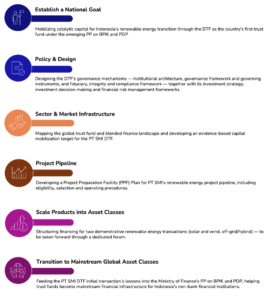
The technical assistance is being delivered by a consulting team from Universitas Gadjah Mada’s Faculty of Economics and Business (“FE UGM”), supported by independent reviewers, under GFI Indonesia’s oversight. On the 14 September, PT SMI, GFI Indonesia, the FE UGM consultant team, and the Ministry of Finance to aligned on the assignment’s objectives and scope, and to seek the Ministry’s direction on how the PT SMI DTF should be aligned with the emerging regulatory framework.
Poppy Ismalina, Ph.D., Country Director, GFI Indonesia, said: “The PT SMI Development Trust Fund is more than an institutional design exercise — it is a live test of how Indonesia’s emerging trust fund regulation can work in practice. With an 85 percent green financing gap, Indonesia needs vehicles that can take risk, lower the cost of capital, blend public and private money, and build the ecosystem around them, the DTF is designed to do all four. By pairing hands-on technical assistance with the policy process, the lessons from this demonstration project will directly strengthen the framework the Ministry of Finance is building for the country’s financial sector. From designing the DTF through to structuring demonstrative renewable energy transactions, this is GFI’s Transactions to Transitions approach in practice.”
Related Content

Insights
08.05.26
Advancing Indonesia’s Climate Finance through a Development Trust Fund

Insights
18.02.26
Turning green buildings into bankable investments: how GFI is mobilising finance for Indonesia’s low-carbon transition
Indonesia's buildings account for a significant share of energy demand and emissions, yet many developers and financiers still perceive green buildings as costly, complex,...

Insights
23.12.25
Unlocking Green Building Finance in Indonesia: the first step toward a National Coalition
On 9 December more than thirty representatives from government agencies, financial institutions, property developers, and international organisations gathered for the Multistakeholder Forum on Cost-Efficient...

12.05.25
Closing the Climate Finance Gap: Indonesia’s Ministry of Finance and Green Finance Institute, UK, Develop Governance Blueprint for the Sustainable Finance Committee
Closing the Climate Finance Gap: Indonesia’s Ministry of Finance and Green Finance Institute, UK, Develop Governance Blueprint for the Sustainable Finance Committee
02.12.25
Enhancing Sustainable Finance Governance in Indonesia
The Role of the Sustainable Finance Committee in Policy Harmonisation and Cross-Institutional Coherence

12.05.25
Investors’ Views on Sustainable Finance in Indonesia
Mobilising Investment for Decarbonisation