











Acting on Resilience: Four Corporate-Led Funding Models That Business Leaders Should Know
by GFI Edge | November 25, 2026
In our last article, we explored how climate and nature risks are no longer a distant threat to corporate supply chains.
Companies are starting to implement strategies to address emerging climate and nature risks, from water scarcity and land degradation to volatility in energy supply and prices.
But similar questions keep arising:
- How do we invest when the assets or landscapes we depend on sit outside our direct ownership and control?
- How can we work with peers on shared supply-chain risks without compromising commercial interests?
- How do we justify investment today when the financial risks may only become visible when disruption occur
Some companies are already exploring the answers through action.
For almost a decade, GFI has been at the forefront of designing, testing and scaling financial solutions for climate resilience and other sustainable outcomes.
We’ve worked with corporates, investors, governments and civil society across the globe, building a network of practitioners actively testing models that tackle these questions.
In this article, we’re highlighting four models we believe have potential for wider application, representing a selection of approaches we have seen or supported.
1. McCain Regenerative Farming Finance
 Helping suppliers overcome the upfront cost of investing in regenerative agriculture.
McCain aims to transition 100% of its global potato acreage to regenerative farming by 2030, but its 3,400 farmers can face significant upfront equipment costs, such as irrigation and minimum-tillage machinery.
To tackle this barrier, McCain has partnered with agricultural lenders – like Credit Agricole, its initial partner bank in France – to offer its farmers low interest loans. McCain subsidises part or all the interest cost, while offering other economic support tailored regionally, such as grants, longer-term offtake contracts and technical assistance programmes.
What began in France has since been replicated across the Netherlands, Poland, the UK, Canada, Australia and New Zealand. With 69% of McCain’s potato acreage now onboarded to its Regenerative Agriculture Framework, the company plans to expand farmer-finance solutions into further markets.[1]
Best suited to: established supply chains where sourcing companies are willing to subsidise financing costs and mitigate credit risks with long-term offtake contracts.
2. Rimba Collective
Enabling competitors to pool funding for shared sourcing landscapes.
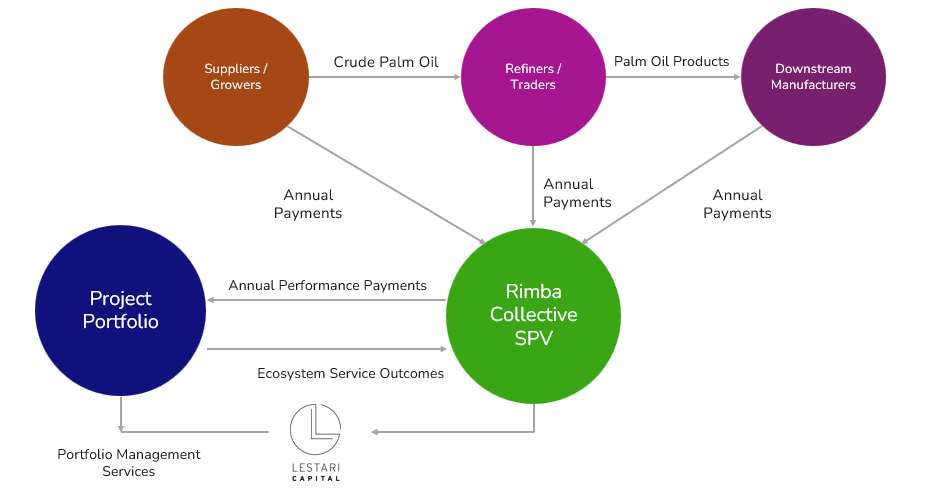
Launched in 2021 by Nestlé, PepsiCo, P&G and Unilever with Lestari Capital, the Rimba Collective enables companies sourcing palm oil from Southeast Asia to collectively finance conservation and restoration across shared sourcing landscapes.
Rather than each company establishing its own projects, these companies make contributions linked to the volume of palm oil they procure, with Lestari Capital pooling this funding and deploying it across a portfolio of conservation and restoration projects that are independently monitored. This allows competitors to share the cost, risk and complexity of protecting the landscapes on which their supply chains depend.
By October 2025, the model had channelled $22.8 million into 17 projects covering 312,000 hectares across Indonesia and the Philippines. Lestari Capital plans to scale this approach into other commodities and geographies.[2]
Best suited to sectors where companies share sourcing landscapes, risks and interests.
3. Kimberley Clark and Maersk’s electric HGV corridor.
 Making the electrification of logistics routes commercially viable through collaboration.
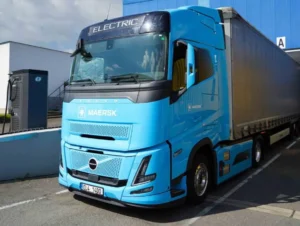
In 2025, consumer goods giant Kimberly-Clark worked with its logistics partner Maersk to electrify a 36km freight corridor between their plant and warehouse in Czechia.
Despite predictable, high-frequency demand, replacing diesel with battery-electric trucks initially appeared nearly twice as expensive per round trip.
Rather than abandon the project, the companies worked together to redesign the operating model, invest in private charging infrastructure and take a longer-term view of the economics, including factoring in future expected diesel costs.
In November 2025, Kimberley-Clark said the project was expected to avoid around 130 tonnes of CO₂e in 2025 compared with diesel, while generating operational data to inform Kimberly-Clark’s wider logistics electrification efforts across Europe, including the potential to electrify key customer delivery routes.[3]
Best suited to: businesses able to co-fund key infrastructure and take a long-term investment view, allowing upfront costs to be recovered through savings over time.
4. Conservation Trust Funds
Using investment returns to create a long-term, stable funding stream for resilience.
Some nature-based resilience projects can deliver significant risk-reduction benefits to corporates but generate limited or uncertain financial returns, making it difficult to justify corporate expenditure.
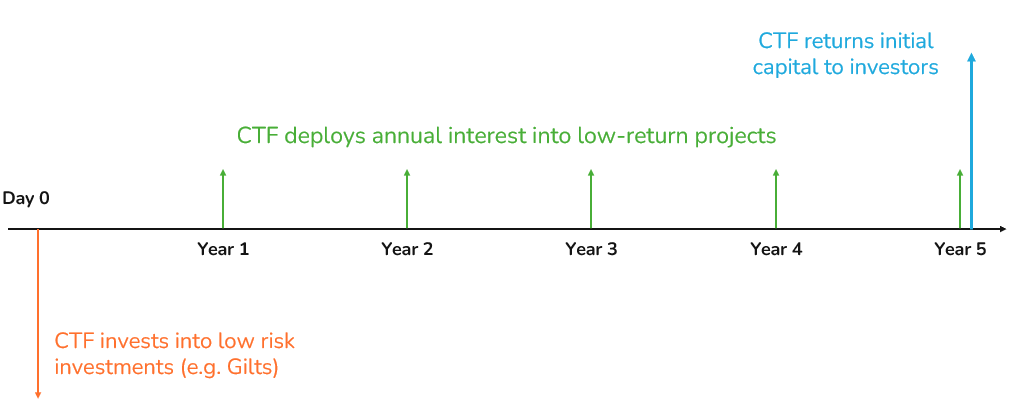
A Conservation Trust Fund offers an alternative: corporate capital, together with philanthropic and mission-aligned funding, is placed into low-risk investments, such as government bonds, with the annual interest income used to fund nature restoration, such as peatland restoration or water stewardship, over longer timeframes.
Rather than spending the original contribution directly, the model aims to preserve the underlying capital, while creating a recurring funding stream.
This can make longer-term commitments easier to accommodate while reducing reliance on annual sustainability budgets.
Best suited to: longer-term resilience or nature interventions with low or uncertain financial returns that make traditional investment challenging.
Different models, shared ingredients for success:
These structures solve different business challenges, but three principles recur:
- Businesses are evaluating investments against future risks, not today’s status quo. The question shifts from “how much positive impact can we claim?” to “what future cost or damage are we avoiding?”
- More innovation lies in the implementation, rather than the instrument. Loans, pooled funds, long-term contracts and endowments only become effective when adapted to operational realities, supply-chain relationships and local conditions.
- Resilience works better when the burden is shared. Suppliers are only part of the picture. Competitors, banks and other organisations exposed to the same risks can all be potential partners.
The GFI sees potential for these and other models to go further and faster.
Growing pools of public adaptation finance, including the EIB Group’s recently announced €30bn adaptation plan, are creating opportunities to blend public and private capital, while better monitoring can build the evidence needed to bring future co-investors to the table.
We will explore these concepts and other market developments in our next and final article of this series – Five Market Signals Shaping the Sustainable Supply Chain Agenda in 2027.
If these approaches resonate with your resilience or sustainability challenges, the GFI Edge team would welcome the opportunity to explore these further with you.
[1] https://www.mccain.com/media/4754/2025-sustainability-report.pdf
[2] https://rimbacollective.com/
[3] https://procurementmag.com/news/kimberly-clark-maersk-embracing-freight-electrification
Photo credits: 1) Credit Agricole, 2) Maersk
If you are considering these questions within your business, the GFI Edge team would welcome the opportunity to explore these further with you.
