













Insights
Accelerating High-Integrity Biodiversity Compensation Systems Worldwide
The Green Finance Institute has announced a new global partnership with the Wildlife Conservation Society, the Environmental Policy Innovation Center, Terrasos and UNDP Biofin to support countries in developing high-integrity compensatory compensation schemes. The Compensatory Conservation Scheme Support (C2S2) Network will support governments in designing, adopting, and implementing schemes such as mitigation banking and biodiversity offsets that align economic development with nature conservation.
Global infrastructure investment – estimated at USD 9 trillion annually – continues to drive biodiversity loss, while financing for nature remains critically insufficient.
Compensatory conservation mechanisms offer a practical, market-based solution. When designed with integrity, they transform environmental compliance into a driver of measurable conservation outcomes.
- The biodiversity compensation market has grown from USD 4.8 billion (2016) to ~USD 6 billion (2024)
- It is projected to reach over USD 30 billion by 2030
Despite this growth, adoption remains uneven due to:
- Fragmented policy frameworks
- Limited institutional capacity
- Inconsistent metrics and monitoring approaches
C2S2 addresses these barriers through coordinated technical assistance, policy support, and capacity-building.
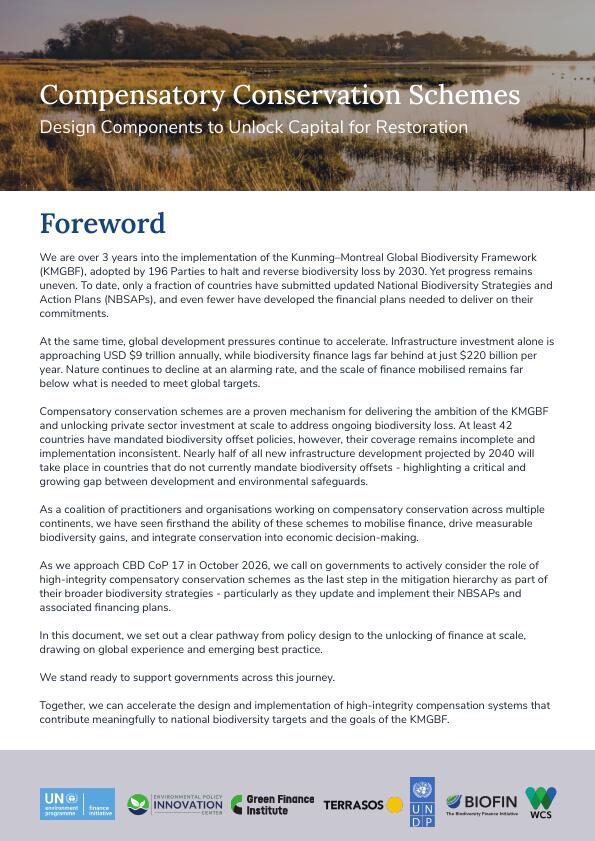
As part of the launch, the C2S2 Network published Design Components for Compensatory Conservation Schemes, which outlines what is required to design, implement, and optimise compensatory conservation schemes, and hosted a webinar with project partners to bring the design components to life by sharing experiences on the ground. Access both below.
Design Components for Compensatory Conservation Schemes
Introductory Webinar
Stay in Touch
Interested governments and partners can find more information and useful resources on the C2S2 Website and can stay in touch by emailing revenues4nature@gfi.green or register your interest below.
Other content
08.06.26
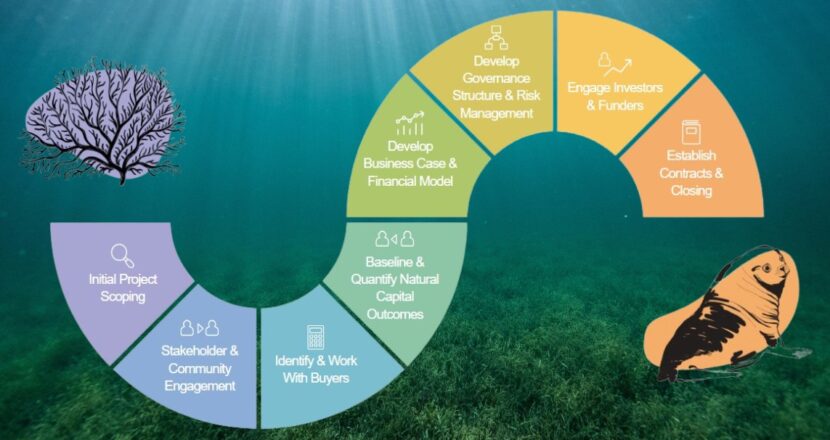
Unlocking Finance for Marine and Coastal Nature Recovery in the UK
Marine and coastal restoration projects can deliver significant environmental, social and economic benefits, but many struggle to access the funding and finance needed to...
27.04.26
Revenues for Nature: From Proven Models to Scalable Systems
The GFI Hive's latest report, “Revenues for Nature: From Proven Models to Scalable Systems,” distils insights from 60 revenue models and financing mechanisms across...

16.04.26
Evaluating eligibility for transition finance: recognising the importance of nature
The GFI Hive team worked alongside the Transition Finance Council (TFC) on its Implementation Handbook: How to Apply the Transition Finance Guidelines, and as...

09.04.26
Getting Started with Nature Data and Metrics: How UK Businesses are Moving from Awareness to Action
Metrics and targets are the fourth pillar of the Taskforce on Nature-related Financial Disclosure’s (TNFD) recommended disclosures. Metrics provide a structured, decision-useful basis for...
01.04.26
Revenues for Nature publishes Marine & Coastal Conservation Guidebook
The Revenues for Nature (R4N) Programme has published a guidebook focused on mechanisms that drive private capital into the protection and restoration of coastal...
17.12.25
Creating a financial system that rewards nature restoration and impact reduction
All organisations and institutions working towards this target of large-scale traditional investment into nature restoration would benefit by collectively considering how we can address...