







Insights
Unlocking Finance for Marine and Coastal Nature Recovery in the UK
On World Oceans Day, the Green Finance Institute (GFI) and Finance Earth are launching a new Marine and Coastal Natural Capital Projects Investment Readiness Toolkit, commissioned and funded by the Crown Estate.
The Toolkit responds to a growing challenge facing marine and coastal restoration projects across the UK: while interest in restoring marine ecosystems is increasing, many projects still struggle to access the funding and finance needed to move from concept to long-term delivery.
Across the UK, communities, charities, local authorities and marine organisations are developing ambitious projects to restore saltmarshes, seagrass meadows, oyster reefs and other coastal habitats. These projects can deliver a wide range of benefits – from increased fish stocks and water quality improvements to carbon sequestration and coastal flood risk reduction. Yet projects are mostly remaining small scale and short term.
Through interviews with project developers, access to funding, both up-front and long-term was identified as a key constraint for scaling marine and coastal restoration. Many of these projects are delivering substantial ecological and social benefits and have successfully developed projects with multiple stakeholders and strong buy-in from local communities. However, this is not yet consistently translating into market opportunities and secure long-term funding.
In 2025, The Crown Estate, in partnership with Finance Earth, Pollination and Blue Marine Foundation, published High Integrity Marine Natural Capital Markets in the UK: A Roadmap for Action, which outlined the key actions required to develop and scale markets for marine and coastal natural capital in the UK. The Roadmap set out seven recommendations across policy, data and financing to help unlock these markets.
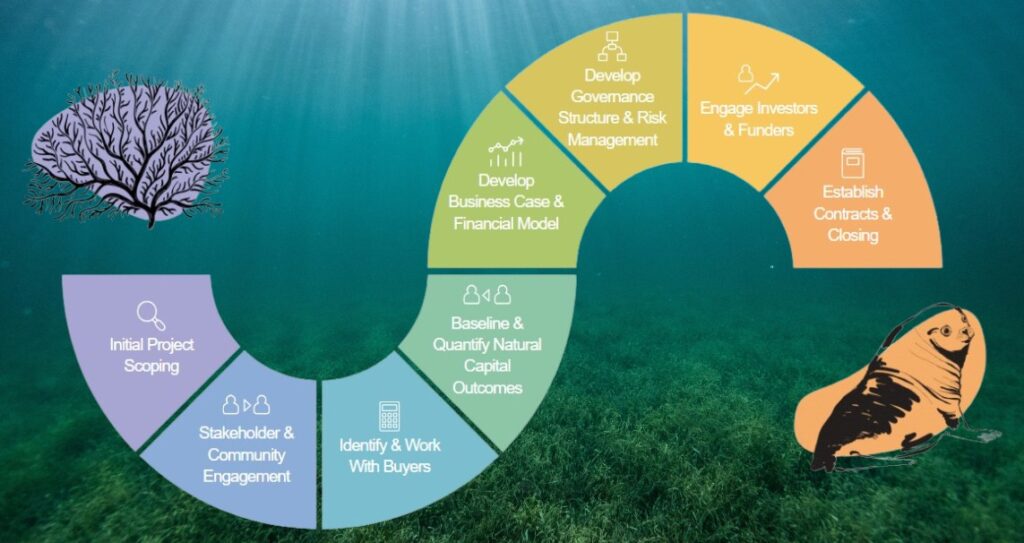
The Toolkit directly addresses Recommendation 7: Build the skills and capacity to harness marine natural capital opportunities.
Barriers to Scale
One reason is that marine and coastal natural capital markets are still emerging.
Unlike some terrestrial markets, where there are now more established standards, revenue models and investment pathways, marine projects often operate in a much earlier-stage environment.
Projects also face practical challenges that are specific to the marine environment:
- A multi-stakeholder landscape that involves regulators, seabed owners, fishers, ports, coastal communities and conservation bodies with diverse interests and priorities for marine ecosystems
- Challenges of working in a tidal environment or at sea, and uncertainty around environmental outcomes
- Limited but growing existing market infrastructure for marine ecosystem services
- Locally specific permitting and licensing requirements
- Need for more standardised methodologies for quantifying and monetising ecosystem benefits
At the same time, many marine restoration projects are being led by organisations with deep ecological expertise but limited experience engaging with private finance, structuring revenue models or preparing investment propositions. The Toolkit is aimed at addressing this knowledge gap and outlining the most common considerations and steps that projects will go through in developing a project that could access markets and attract private capital.
Beyond the Toolkit
While the Toolkit is an important step, it is only one piece of a much broader transition.
Standards and codes for data collection, project development and monitoring are under development across many marine ecosystems. Greater engagement with potential buyers is needed to better understand demand for marine ecosystem services and identify barriers preventing projects from accessing private capital. Licensing, leasing, permitting and consent processes are new and challenging for many project developers, highlighting the need for clearer guidance and more streamlined pathways.
At the same time, more support is needed for projects in their earliest stages. Upfront funding for project scoping, baselining and design can help projects move from concept to delivery, while longer-term financing models are needed to ensure restoration outcomes are maintained over time.
Addressing these barriers will require coordination and collaboration between government, regulators, local authorities, corporates, project developers, funders and financial institutions.
Looking ahead at the opportunity
The UK has an opportunity to become a leader in high-integrity marine natural capital projects.
Around the country, organisations are already demonstrating what is possible: restoring oyster reefs to improve water quality and biodiversity, recovering seagrass meadows to support fisheries and carbon sequestration, and developing regenerative ocean farming models that create year-round employment in coastal communities.
But scaling this work will require more than ambition.
Project developers need access to practical tools and support to develop investable projects. Funders and investors need a stronger pipeline of high-quality opportunities. Businesses need clearer pathways to support marine restoration through the purchase of environmental outcomes. And policymakers and regulators need to continue creating the enabling conditions for these markets to develop with integrity.
The Toolkit is intended as a practical resource for all of these audiences. We encourage project developers, local authorities, environmental organisations, funders and businesses to use it to identify opportunities, strengthen projects and help build the next generation of marine and coastal restoration initiatives.
On World Oceans Day, we hope this Toolkit helps support the next generation of marine and coastal restoration projects — and contributes to building a more resilient and nature-positive future for UK seas.
Other content
27.04.26
Revenues for Nature: From Proven Models to Scalable Systems
The GFI Hive's latest report, “Revenues for Nature: From Proven Models to Scalable Systems,” distils insights from 60 revenue models and financing mechanisms across...

16.04.26
Evaluating eligibility for transition finance: recognising the importance of nature
The GFI Hive team worked alongside the Transition Finance Council (TFC) on its Implementation Handbook: How to Apply the Transition Finance Guidelines, and as...
13.04.26
Accelerating High-Integrity Biodiversity Compensation Systems Worldwide
The Green Finance Institute has announced a new global partnership with the Wildlife Conservation Society, the Environmental Policy Innovation Center, Terrasos and UNDP Biofin...

09.04.26
Getting Started with Nature Data and Metrics: How UK Businesses are Moving from Awareness to Action
Metrics and targets are the fourth pillar of the Taskforce on Nature-related Financial Disclosure’s (TNFD) recommended disclosures. Metrics provide a structured, decision-useful basis for...
01.04.26
Revenues for Nature publishes Marine & Coastal Conservation Guidebook
The Revenues for Nature (R4N) Programme has published a guidebook focused on mechanisms that drive private capital into the protection and restoration of coastal...
17.12.25
Creating a financial system that rewards nature restoration and impact reduction
All organisations and institutions working towards this target of large-scale traditional investment into nature restoration would benefit by collectively considering how we can address...