













Guidebooks
Guidebooks

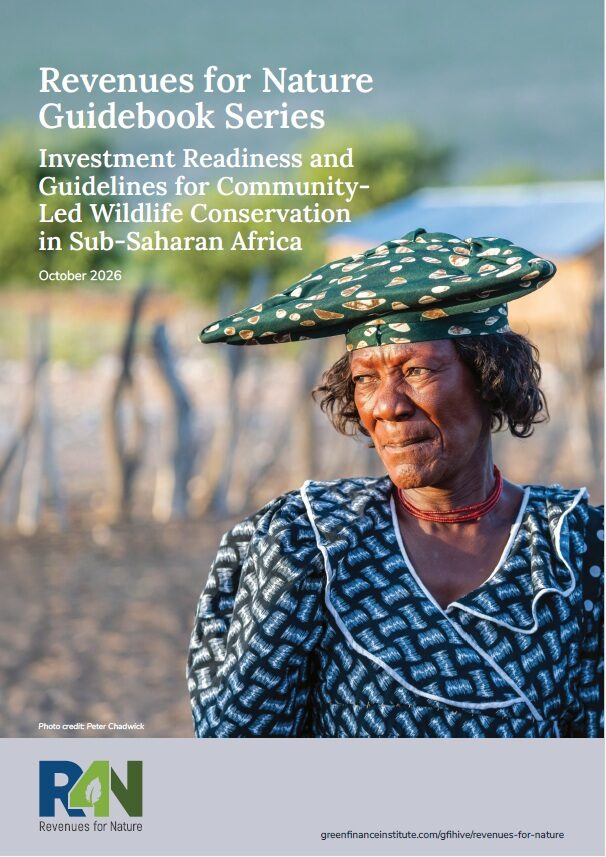
Investment Readiness and Guidelines for Community-Led Wildlife Conservation in Sub-Saharan Africa
This guidebook examines what is needed to make community-led wildlife conservation investment-ready and scalable across Sub-Saharan Africa. Drawing on case studies from across the region, it explores investment readiness, risk management and enabling policies that can help communities capture greater value from wildlife-based enterprises while attracting long-term private capital.
Payments for Ecosystem Services in Sri Lanka
This guidebook presents a practical roadmap for institutionalizing Payment for Ecosystem Services (PES) in Sri Lanka. Drawing on six case studies of PES and PES-like initiatives, the guidebook demonstrates the growing potential of PES in Sri Lanka while identifying key challenges—such as fragmented implementation, weak coordination, and limited monitoring systems—and outlines pathways for establishing a more effective national PES framework.
Revenue Models and Financing Mechanisms for Protecting and Restoring Coastal and Marine Ecosystems
This guidebook explores how innovative revenue models and financing mechanisms can mobilise private capital to support the protection and restoration of coastal and marine ecosystems. Drawing on a series of case studies, it examines how different approaches—from user
fees and payments for ecosystem services to blue bonds and debt-for-nature swaps—have been designed and implemented in practice.
Revenue Models and Finance Mechanisms for Wildlife Conservation in Sub-Saharan Africa
This guidebook examines four revenue and financing models that support wildlife conservation across Sub-Saharan Africa. It is designed to assist policymakers, practitioners, investors, and conservation organisations in understanding how private capital can strengthen the resilience of protected areas and wildlife-rich landscapes. It highlights the enabling conditions that allow these models to mobilise investment, deliver measurable ecological outcomes, and generate benefits for local communities.
Nature-based Revenue Models in Agriculture, Food and Fisheries Supply Chains, Global
This Guidebook highlights four supply chain models that mobilise private sector investment to reduce environmental impact and restore ecosystems. It emphasises collective corporate action in support of forest conservation, the blue economy, and resilient landscapes. The Guidebook also provides summaries of each model, their development, and key lessons for replication and scaling.
Nature-based Models for Unlocking Private Investment into Freshwater (Expanded Edition), Global
This Guidebook expands upon Part 1, published October 2024, focusing on 10 examples of models that leverage private capital to improve freshwater quality and availability in diverse regions. It provides summaries of the models and their development, as well as key lessons learned and considerations for replicating and scaling these models. This edition also includes insights on collaborative efforts to improve water resources, highlighting the benefits of cross-sector, multistakeholder collaboration to share costs, de-risk investment and catalyse change at the catchment scale.
Great bear Rainforest Project Finance for Permanence, Canada
The Great Bear Rainforest Project Finance for Permanence is an Indigenous-led conservation financing model that supports stewardship of the globally-significant Great Bear Rainforest on the west coast of Canada. Co-designed by First Nations, federal and provincial governments, conservation organisations, and philanthropic partners, the model adapts large-scale infrastructure project finance to support Indigenous-designed conservation and community well-being projects in perpetuity.
Living Amazon Mechanism, Brazil
The Living Amazon Mechanism (LAM) is an innovative finance approach that channels commercial and concessional capital into socio-biodiversity value chains across the Brazilian Amazon. The LAM pairs a credit facility with a long-term technical assistance program to fortify sustainable supply chains for non-timber forest products (NTFPs). The guidebook unpacks the LAM’s value proposition, financial architecture, governance model and monitoring framework, weaving in insights from the 2023–2024 pilot.
Biodiversity Net Gain, England
Biodiversity Net Gain (BNG) is a policy in England that requires major and small developers to deliver a 10% gain in biodiversity. With a focus on the implementation of BNG in the UK, the Guidebook will detail the functioning, challenges and opportunities of BNG in mobilising private sector financing to generate nature positive outcomes. Necessary policy requirements for the rolling out of BNG in various contexts will also be identified.
Wetland Mitigation and Endangered Species Habitat Banking, U.S.
The US has two major offset and compensation systems driven by the Clean Water Act for wetlands and streams, and the Endangered Species Act. Both laws include a goal of “no net loss” and ask for adherence to the mitigation hierarchy, requiring avoidance, then minimisation of impacts, then compensatory mitigation. The Guidebook will detail associated banking mitigation mechanisms and highlight key requirements in successfully replicating and scaling these models.
Habitat Banks, Colombia
The establishment of a Habitat Bank system was introduced in Colombia as a way to improve the efficiency of environmental offsets, facilitating the development of collective schemes and allowing environmental authorities to more easily track their progress. This Guidebook details the policies of this model alongside the status of its supply and demand. A comparison with US Mitigation Banking is provided throughout the Guidebook, along with practical lessons learned to inform the replication and scaling of this model.
Nature-based Models for Unlocking Private Investment into Water Quality and Availability, Part 1
This Guidebook introduces a number of models which mobilise private sector financing to improve freshwater quality and availability in a diversity of regions. The Guidebook will describe the key features of these models, focusing on the concrete steps to replicate and scale them along with key barriers and lessons learned. The Guidebook will explore models such as Payments for Ecosystem Services, Compensatory Offsetting, Water Funds and innovative water tariff structures, with examples from Japan, Ecuador, Peru, England, and Kenya.
If you would like to learn more about these Guidebooks or the Revenues for Nature (R4N) programme, please contact us at revenues4nature@gfi.green.