














Cassowary Credit Scheme
Cassowary Credit Scheme
| Title | ENVOMARK Cassowary Credit Scheme |
| Country/Location | Wet Tropics, Australia |
| Investment to Date | Undisclosed |
| Revenue Model | Selling biodiversity credits to buyers such as government, private sector (e.g. corporates) and financial institutions |
| Private Investment/Finance Structure | Private sector purchase of biodiversity credits |
| Public/Philanthropic Investment | Funding for scheme development from Queensland Government’s Land Restoration Fund |
| Env/Social Impact | Habitat Restoration, Rainforest Conservation, Improved Soil Health and Biodiversity Uplift |
Summary
The Cassowary Credit Scheme is a voluntary biodiversity credit scheme that was designed to improve rainforest condition in the Wet Tropics, Australia. The scheme was designed by Terrain NRM, a not-for-profit which specialises in natural resource management and is now managed by Eco-Markets Australia, an independent administrator, following scheme approval through the ENVOMARK Value Nature Framework. One credit represents a quantified and verified amount of benefit to rainforest biodiversity achieved, not promised. Once a project has been verified, the ENVOMARK high-integrity assured Cassowary Credits are issued and can be purchased by governments, philanthropists and private sector including financial institutions.
Introduction
The Wet Tropics located in Northeast Australia, is recognised as one of the most biodiverse regions and oldest tropical rainforest in the world. The rainforest supports half of Australia’s bird specifies, a third of its mammals and over 700 vertebrate species. Additionally, it is one of the only places on earth where two world heritage sites sit side by side: the Wet Tropics rainforest and the Great Barrier Reef – highlighting their ecological interconnection, as land management in the Wet Tropics directly influences reef health through sedimentation, nutrient runoff, and pollution.
Climate change, along with other threats like invasive weeds are impacting the landscape and landscape-scale restoration is essential to build ecosystem resilience and restore functional ecological connectivity.
The ENVOMARK Cassowary Credit Scheme is a voluntary biodiversity market scheme designed to increase investment in rainforest restoration. The Rainforest Replanting Methodology is the first methodology approved under the Scheme. It incentivises project operators to undertake restoration activities (such as reinstating, repairing and enhancing rainforests or reducing threats such as weeds) to improve the rainforest condition in the Wet Tropics. The scheme targets land that has not been cleared of native vegetation within five years of the submission of a project.
An ENVOMARK Cassowary Credit is a tradeable unit that represents a quantified and verified amount of benefit to rainforest biodiversity achieved by a Project, as well as co-benefits to regional communities, including Rainforest Aboriginal people.
One Cassowary Credit = X outcomes/activity over Y area for Z time period leading to positive outcomes (e.g. restoration or protection).
The biodiversity credit scheme is independently managed and administered by Eco-Markets Australia. It uses standard, accounting methodologies, independent auditing and a Registry to measure, verify and track the benefits to rainforest biodiversity. Cassowary Credits can be generated when the standard and relevant methodology requirements have been met, measured and independently verified.
It is a mechanism that enables investors such as governments, philanthropists or corporates to pay landholders and land managers to undertake rainforest restoration activities.
Development and administration of the scheme
The ENVOMARK Cassowary Credit Scheme was developed in response to the growing consensus that a market mechanism was needed to restore rainforests degraded by agricultural expansion, residential development, and infrastructure projects, with further pressures from invasive species, disease, and surrounding land uses.
Terrain NRM, a not-for-profit which specialises in natural resource management, developed the concept in 2019. The scheme was later designed with public funding from the Queensland Government’s Land Restoration Fund – a type of investment readiness fund for carbon projects across Australia – and the World Wildlife Fund. A working group, which consisted of technical experts, supported the project’s development and Traditional Owners advised on design and potential benefits to Rainforest Aboriginal communities. In 2025 the Scheme launched and is piloting its first projects in a beta phase, enabling fine tuning to scheme documents and templates in 2026 with broader roll out to follow.
Eco-Markets Australia – Australia’s first independent voluntary environmental markets administrator which also administers the ENVOMARK Reef Credit Scheme – manages and administers the ENVOMARK Cassowary Credit Scheme. It is responsible for program oversight, including project registration, validation, monitoring and the transparent issuance and tracking of credits through a publicly accessible Registry.
Like the Reef Credit Scheme, the Cassowary Credit Standard sets the rules and requirements of the program, including the development of methodologies, the validation, registration, monitoring, verification, crediting, issuance and transaction requirements for all restoration projects. Where possible, the standard looks to align with global standards and initiatives such as the International Advisory Panel on Biodiversity Credits (IAPB) High-level Principles Framework, and the Kunming-Montreal Global Biodiversity Framework.
For example, the ENVOMARK Cassowary Credit Scheme reflects the High-Level Principles through its approach to credit issuance and tracking, whereby independent administration through EMA ensures that credits are issued and tracked by a third party, separate from project proponents. In addition, the mechanism by which biodiversity outcomes are measured and converted into defined, quality-assured credits is publicly disclosed through the methodology and registry, supporting transparency and accountability.
The Scheme also embeds strong alignment with principles relating to Indigenous Peoples and Local Communities involvement in governance. This was a core priority throughout its development, ensuring meaningful participation across the project lifecycle. Where projects impact Indigenous Peoples and local communities – whether through land use, natural resource access, or cultural and environmental considerations – it is a requirement that affected communities are given the opportunity to participate fully in project design, implementation, and oversight. This approach helps ensure that their rights, interests, and cultural well-being are respected and upheld.
The scheme has one approved methodology that project proponents can use to develop restoration projects and generate credits: The Rainforest Replanting Methodology.[1]
The Rainforest Replanting Methodology measures and quantifies changes in the condition of rainforest vegetation through rainforest replanting and maintenance activities. Projects and activities can include re-establishing rainforest vegetation on cleared or heavily modified land through revegetation (i.e., direct planting of stems and/or direct seeding). Specific planting techniques however are not specified under the methodology. Projects are aiming to improve rainforest condition according to a set number of indicators and credits are based on the additional biodiversity benefits delivered in accordance with the methodologies. Projects under the Rainforest Replanting Methodology generate Cassowary Credits over a 25-year crediting period.
Anyone can develop new methodologies for approval under Eco-Markets Australia’s ENVOMARK Value Nature Framework or suggest changes to approved methodologies. New methodologies are first screened for adherence to the Cassowary Credit Guide and Cassowary Credit Standard, before being submitted to the Technical Advisory Committee (TAC) for independent peer review and go through a public consultation and peer review.
Developing projects and generating credits
The generation of ENVOMARK Cassowary Credits involves several key stakeholders, with different roles, purposes and interests:
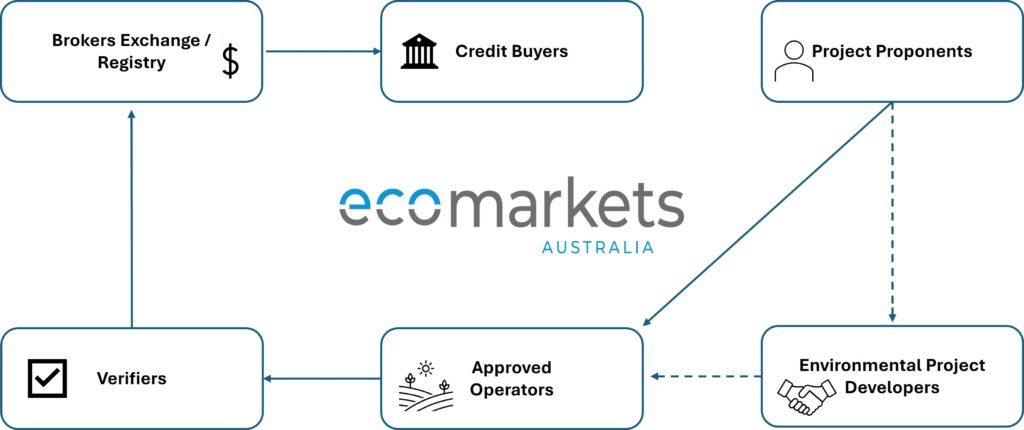
- Project proponents – responsible for designing and carrying out the project and is responsible for reporting and outcomes. This could also be a project developer who has entered into a land agreement with the landowner.
- Approved operators – approved by the secretariat and are responsible for delivering on-ground restoration and preservation work. The scheme prioritises Rainforest Aboriginal People in delivering projects
- Verifiers – responsible for delivering independent verification services
- Brokers – project proponents can use a broker to sell their credits, while all transactions are recorded via the public registry
- Credit buyers – anyone including private sector who would like to purchase credits
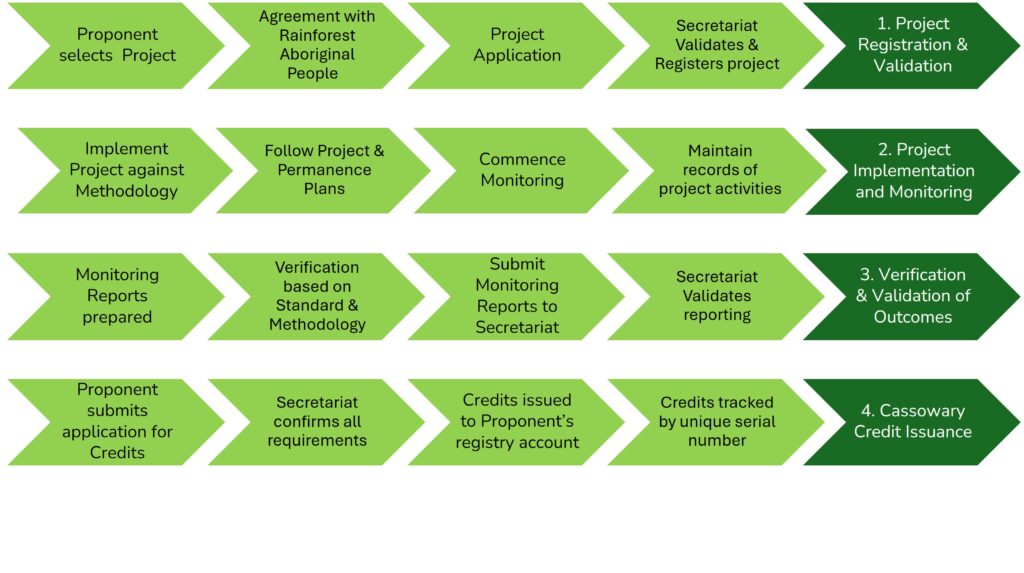
The steps below summarise the process a project proponent undertakes to generate, issue, and sell Cassowary Credits:
Demand
It is anticipated that demand for Cassowary Credits will be voluntary and driven by the private sector including banks, those that have strong ESG commitments and organisations with local footprints. Purchase of credits cannot be used for offsetting but instead can be used for contributory claims purposes such as voluntary reporting and disclosure under TNFD and Australia’s New Mandatory Climate Reporting legislation.
While credits won’t be generated for another twelve months there’s a strong focus on engaging investors early to build demand. Project Proponents are also exploring the possibility of offtake agreements to secure future demand. The price of credits will be driven by the market and transactions will take place independently between buyer and seller. To recoup costs, credits will have to be sold initially using a cost-plus model.
Additionally, demand for credits can be driven by stacking Cassowary Credits with Australian Carbon Credit Units (ACCU). Both credits can be generated on the same parcel of land for emission reduction and nature repair, and credits can be sold separately or bundled together, offering a diversified income stream.
| ACCU | Cassowary Credits | |
| Method | Reforestation by Environmental or Mallee Planting Methods | Rainforest Replanting Methodology |
| Objective | Store Carbon in native vegetation | Improve the condition of rainforest habitat |
| Activities | Planting native species:
· As seeds or tubestock · In areas that are linear belts or blocks · At a density that allows them to achieve forest cover · With the potential to reach heights of at least 2m and provide cover over a minimum of 20% of the land |
Plant and maintain native rainforest plant species that could occur naturally at the Project Are to re-establish rainforest vegetation on cleared land.
Condition Score · Native tree canopy over · Species richness of native plant recruits · Density of medium-large stems of native trees |
Source: Eco-Markets Australia
Projects must meet additionality criteria to generate stacked credits. Both credits must measure separate and independent outcomes to prevent double counting. To stack credits, the project must first be registered under the ACCU scheme and then separately under the Cassowary Credit Scheme. To meet additionality requirements in the Cassowary Credit Scheme, projects must deliver benefits to rainforest biodiversity that would not have occurred without the project. To ensure that only the biodiversity outcome resulting from the Cassowary Credit project contributes to the calculation of Cassowary Credits, a counterfactual deduction is applied (i.e. the condition score achieved by an ACCU project is subtracted from the condition score achieved by a Cassowary Credit project.[2]
Supply Side
The ENVOMARK Cassowary Credit Scheme requires project proponents to use local businesses and service providers that have been accredited as Approved Operators to plan and implement the projects. This includes engaging with Indigenous Peoples and Rainforest Aboriginal People. By prioritising local communities and Indigenous Peoples the scheme aims to support the growth of a local restoration industry while aligning with regional values. It also creates opportunities for training, employment, and business development, supporting wider social and economic benefits in the region.
The first project was registered under the scheme in May 2025 and can be found on the public Registry. Led by the Cassowary Coast Regional Council, the project will restore land that has been cleared for cattle grazing to native rainforest (the first stacked biodiversity and carbon credit (ACCU) project in Australia). The second project registered August 2025 is led by Jabalbina Yalanji Aboriginal Corporation with on-ground works all being undertaken by Traditional Owners. The project aims to restore the site’s high cultural significance to its Eastern Kuku Yalanji (Julaywarra clan) Traditional Owners and its habitat value for southern cassowaries and other species. Credit generation for both projects is expected in 2027. Further details can be found on the public registry.
Monitoring, reporting and verification
All Projects are required to use Approved Operators for independent Monitoring and Reporting, with third-party, independent Validation conducted by the Secretariat.
Indicators that are used to measure the improvement of rainforest condition under the Rainforest Replanting Methodology include [3]:
- Average canopy cover of native tree species (%)
- Species richness of native tree, shrub or vine recruits (number different species)
- Density of medium-large diameter stems (per hectare)
- Non-native grass cover
- Non-native plant abundance
Cassowary Credits are only calculated for rainforest biodiversity benefits that result directly from the project activities and are additional to any benefits that would have occurred without the project.
Replicating and Scaling
The ENVOMARK Cassowary Credit Scheme aims to contribute to the Australian Governments 30×30 commitment and to the preservation of the Wet Tropics World Heritage Area. While initial focus is on establishing the scheme and building demand, Eco-Markets has released its Australasian Biodiversity Improvement Standard for public consultation, closing 24th May 2026, to continue to scale nature repair.
One key feature of building out the scheme is expanding and developing more methodologies. New methodologies could include protection measures such as feral animal control. Without expanding the methodologies that underpin credit generation, innovation risks stalling, and limited options can restrict both participation and uptake. Additionally, the availability of upfront funding to develop these methodologies remains a challenge in scaling the model. Eco-Markets are exploring ways to make it more accessible such as a Market Activation Fund.
The cost of participating in the scheme is also proving to be a barrier. Eco-Markets have introduced ways to reduce cost burdens such as reducing registration fees for NGOs. Another challenge is that many participants (especially land managers) may not fully understand the scheme, its benefits, or how to engage with it. A focused effort on awareness-raising and education is essential to build trust and encourage broader involvement.
Lessons Learned
- Independent governance is critical to integrity and transparency. Oversight by an independent entity (e.g. EMA) strengthens credibility and market confidence.
- Alignment with global frameworks and other nature markets helps reduce fragmentation and can enhance environmental co-benefits.
- Designing for compatibility with other environmental markets (e.g. credit stacking where appropriate) can improve financial viability and attractiveness for land managers.
- Market participation is constrained by several barriers, including: upfront project capital costs; time and cost to develop new methodologies; verification costs, and upfront project risk. Targeted mechanisms are needed to address these barriers. EMA is exploring solutions such as an impact-focused Market Activation Fund to support project capex and methodology development, while addressing additionality and claims in line with global best practice.
- Demonstrating high-integrity, measurable outcomes is essential to building trust and demand. Models such as Reef Credits show how independently verified, quantified environmental outcomes can underpin credible market instruments and attract both ESG and compliance buyers.
- Scaling the market will require more approved methodologies, more project proponents, and streamlined processes that lower barriers to entry while maintaining integrity.
- Policy alignment is key to enabling scale and pace. Coordination with broader regulatory frameworks (e.g. Nature Repair Market and EPBC Act reforms) and continued innovation – such as enhanced registries (e.g. blockchain-enabled systems) – can improve transparency, traceability, and confidence in credit attributes.
Updated as of May 2026
[1] Eco-markets (2025). Rainforest replanting methodology for the Cassowary Credit scheme
[2] Eco-Markets (2025) Cassowary Credits Stacking Guide
[3] Eco-Markets (2025) Rainforest Replanting Methodology Explanatory Statement