












Private Revenue Mechanisms and England’s Terrestrial Protected Sites
Private Revenue Mechanisms and England’s Terrestrial Protected Sites
The Funding Gap Putting England's Protected Sites at Risk
Protected sites are the cornerstone of England’s approach to conserving biodiversity and are central to reaching England’s ‘30×30’ target to protect 30% of land and sea by 2030. However, despite their legal protections, less than 40% of protected sites are in favourable condition.[1] As a result, it has been estimated that only 3% of England’s land is currently meeting the criteria required to count towards the 30×30 target.[2]
Restoring these existing sites – let alone designating more protected sites – requires substantial long-term investment, yet public funding alone is widely recognised as insufficient. The Office for Environmental Protection (OEP)’s review of terrestrial & freshwater protected sites recommends more resourcing and funding, framing this as a time-critical recommendation to deliver the Government’s legal targets set out in the Environmental Improvement Plan. This raises the question:
If public funding for protected sites is constrained, how can they be resourced?
As a result, some policy and conservation stakeholders are exploring how protected sites can use private revenue mechanisms in a way that improves their ecological uplift. Private finance was referenced in both the OEP’s 2025 review and more recently Defra’s 30×30 Delivery Plan update. However, both of these refer to the use of private finance in broad terms, with less detail on how mechanisms such as Biodiversity Net Gain, carbon finance and payments for natural flood management fit within the regulatory and ecological context of protected site management.
Building on this interest, the GFI has written a report in collaboration with expert project developer and policy stakeholders to explore this intersection between private revenue mechanisms and protected sites in greater depth. This report, written for those with a working knowledge of private revenue mechanisms in the UK, does not provide a definitive answer to whether these mechanisms should be used in the context of protected sites. Instead, it addresses the question:
Under current regulatory and market rules, to what extent can protected sites use private revenue streams?
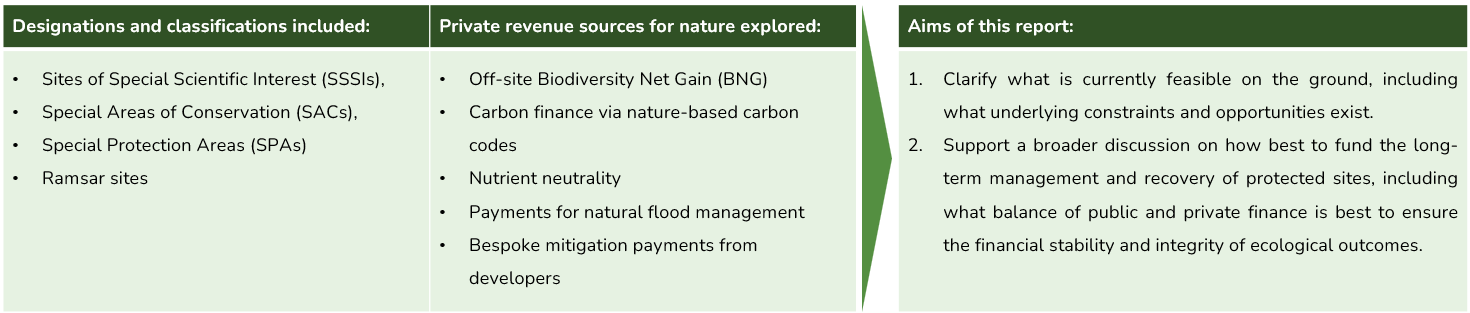
This report covers the below protected site designations and private revenue mechanisms, with the following aims:
Key Learnings
1. There is limited evidence that private finance is contributing directly to works within protected site boundaries
Despite growing interest in nature markets and private investment, the report found only limited evidence of private revenue mechanisms being used directly within protected site boundaries. Current regulatory frameworks, consent processes and additionality requirements often restrict their application.
2. Different finance mechanisms have very different levels of compatibility
The report found substantial variation between mechanisms, including how the concept of legal additionality is applied. Biodiversity Net Gain and nutrient neutrality currently face significant barriers within protected sites, while peatland carbon projects and some natural flood management interventions appear more compatible where consent can be secured.
3. The strongest opportunities may sit outside protected site boundaries
Currently, the strongest application of private revenue mechanisms may be supporting habitat creation, restoration and ecological connectivity in the wider landscapes surrounding protected sites, helping reduce external pressures and improve resilience rather than funding activities directly within protected sites themselves.
4. Emerging policy reforms could change the picture
Protected Site Strategies, Local Nature Recovery Strategies and Environmental Delivery Plans are all exploring more strategic, landscape-scale approaches to nature recovery. These emerging frameworks may create new pathways for private investment to support protected sites in the future.
Both private revenue mechanisms for nature and the frameworks governing protected sites in England continue to evolve. As such, the current limited compatibility identified in this report should not be interpreted as evidence that future opportunities will not exist. Instead, the report highlights the importance of carefully considering what is the optimal approach to fund the maintenance and expansion of protected sites.
References
- Statistic from Natural England’s Report Unit Condition Summary tool, accessed 03 August 2026 –
https://designatedsites.naturalengland.org.uk/ReportUnitConditionSummary.aspx?SiteType=ALL - Wildlife and Countryside Link (2025) 30by30 2025 UK Progress Report: Progress towards 30by30 on land. Available at:
https://www.wcl.org.uk/assets/uploads/0/WCL_04_30x30Report2025_DIGITAL.pdf