














Insights
Creating a financial system that rewards nature restoration and impact reduction
Creating a financial system that rewards nature restoration and impact reduction
December 16, 2025 – In our last edition of GFQ, we wrote of the need for a whole systems approach in order to scale investment into nature restoration and Nature-based Solutions (NbS), focusing on where philanthropy can play a catalytic role.
This holistic view is not just relevant to philanthropy, however. All organisations and institutions working towards this target of large-scale traditional investment into nature restoration would benefit by collectively considering how we can address every step – how we can use policy, regulation and fiscal incentives to unlock future investment, how we can simultaneously build demand and supply and the market infrastructure that enable revenue models and investment returns, and how we can create a financial system that rewards nature restoration and impact reduction.
We hesitate to use the word ‘step’ because this pathway to finance at scale is not linear and can be both top-down and bottom-up.
All organisations and institutions working towards this target of large-scale traditional investment into nature restoration would benefit by collectively considering how we can address every step.
Through our nature work, we have mapped what we believe to be the entire pathway as below, deploying GFI’s Transactions to Transitions Greenprint.
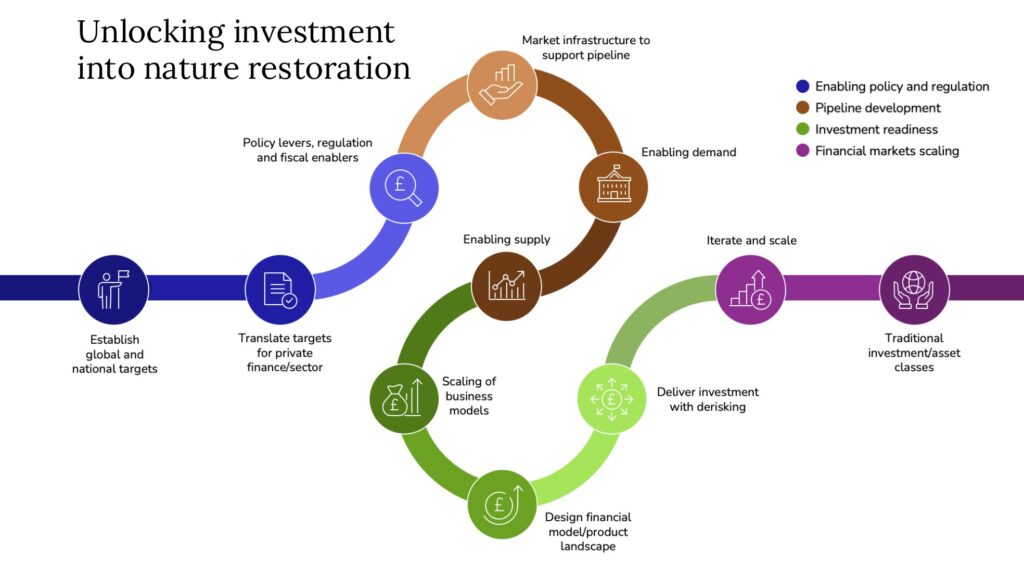
These pathways will differ country-to-country as well as mechanism-to-mechanism, but through our Revenues for Nature work, we already see some clear gaps and solutions that, if we collectively prioritised, could unlock multiple steps at once.
Enabling policy and regulation
These ‘first’ three steps are about ensuring that national and regional environmental policy and regulation are in place that unlocks private sector investment.
There are two key immediate solutions we see in this section of the pathway. The first is ensuring that environmental targets are developed with the understanding that the private sector must co-deliver. Too often environmental policies are set with no direction for the private sector. A solution we are working on with WWF-UK, is Nature Positive Transition Pathways (NPPs). NPPs translate each environmental target into actions that different sectors will need to deliver. Developed with the private sector and finance sector, these actions will also uncover where both policy support and investment will be needed.
Also in this section, one action all governments could take now to drive private sector investment into nature restoration is to establish compensatory schemes. Impact on our natural environment is only going to increase due to population increases and demands for infrastructure and housing. Compensatory schemes, that ensure environmental damage is offset (following the mitigation hierarchy), have been used successfully for decades in countries like the US to deliver net offsets or net gains.1 Many governments in Africa, SE Asia, and Latin America are now revisiting this tool.
Pipeline Development
These three steps focus on the creation of revenue models. A common assumption is, once disclosure frameworks are in place, and once governments have made commitments to the environment and set out a plan of action, demand and supply will automatically appear. Our experience, however, is that this is not the case, and it is this at this critical juncture where momentum can stall.
The biggest challenge we have seen in this section of the pathway is demand. Without regulation or a clear business case, there can be a pipeline of ready projects looking to sell water quality or quantity solutions, flood risk reduction, carbon credits or biodiversity credits, yet with no buyers – and therefore, no revenue model.
Support is needed to help businesses quantify and demonstrate a clear internal business case for investment and to build confidence that the supply side will deliver the required impacts that justify expenditure. Data and evidencing are, therefore, crucial at this stage, as is the commitment from large multinationals to work collectively on business case development. The insurance sector has a role to play given their ability to model and price risk and resilience.
Investment Readiness
These three steps are about moving from revenue model development and business investment, into unlocking the financial sector – often called ‘investment readiness’.
Here we would benefit by replicating and scaling successful revenue models that have matched demand and supply – such as the Fisheries Improvement Fund from Finance Earth in which offtakers of a fishery pay for improvements to its ecological status, or the Rimba Collective, in which companies procuring palm oil pay for reforestation projects to secure their supply chain and meet reporting requirements. There are multiple examples of such models that can and should be replicated in other geographies or sectors, but development funding costs can make it challenging to replicate and scale. Sharing learnings among these models can also speed up success rates.
Also in this section is the challenge of a lack of derisking capital. Concessionary capital can often crowd in multiples more from commercial-return-seeking investors, deliver greater impact and provide clear exit strategies and therefore be an exciting alternative to traditional grant funding.
Financial Market Development
In this section, where we are unlocking investment opportunities for institutional investors and pension funds that align with global goals to reduce negative impacts and increase nature restoration, we see some clear systemic gaps.
These include building out valuations of companies that reflect their progress on reducing harmful impacts (for example, investing in impact-reduction technologies or practices), and on building climate-resilient supply chains and operations.
We need banks to price their lending rates in a way that rewards businesses that are reducing nature-related risks. Ratings agencies and insurers need to be able to integrate nature-related risks into their risk assessments and premiums.
In 2026, as we head towards CBD COP17 in Armenia, the GFI will be working with partners across sectors and countries to iterate the pathway and identify solutions for these crucial gaps.
This article was originally published in the December edition of Green Finance Quarterly. Read the full publication here.
Other content
28.11.25
Unlocking Finance for Sustainable Supply Chains
The latest R4N Guidebook Nature-based Revenue Models in Agriculture, Food and Fisheries Supply Chains, explores collective corporate action models and demonstrates how Nature-based Solutions...

25.11.25
GFI Hive, Finance Earth & The Crown Estate launch Marine & Coastal Investment Readiness Toolkit Consultation
The Green Finance Institute, in partnership with Finance Earth and The Crown Estate, has today published initial guidance for a new Marine and Coastal...

17.09.25
Catalytic Philanthropy: How a holistic approach could unlock trillions in investment
As individuals, charitable trusts, foundations and endowments review their budgets ahead of 2026, the question, therefore, is: how can we ensure that philanthropic funding...

17.09.25
From principles to practice: embedding Indigenous leadership in nature finance
While global commitments and the development of shared principles and guidance are critical steps, the task now is translating these into practical and innovative...

17.09.25
From risk to resilience: financing nature at scale
As the climate crisis intensifies and ecosystems edge toward tipping points, the private sector is beginning to reckon with a fundamental truth: environmental risk...

17.09.25
Regulated nature offsets: the key to unlocking the billions required
Mitigation banking, rooted in laws allowing no net loss of wetlands and streams, has transformed the way private capital supports nature-positive investments.
