









The Insurance Sector and Natural Flood Management. Building the evidence, increasing commercial understanding, and upscaling the funding for NFM: An NFM Research Fund

Jul 23, 2024

Cross-sector, expert-led natural flood management (NFM) group recommends the formation of an NFM Research Fund to channel funding from the insurance sector into NFM projects across the country, while simultaneously building the evidence-base and commercial understanding within insurers.


Following the Financing Natural Flood Management report launched in March 2024, that highlighted the importance of building demand for nature-based flood risk outcomes within the private sector, the Green Finance Institute has today published a short paper focussing on the insurance sector as a potential buyer. The paper highlights some of the current challenges associated with the sector as a buyer of NFM outcomes, and recommends the formation of an insurance sector-led NFM Research Fund.

Designed with guidance from the insurance sector and wider industry, flood, nature, and finance experts, the proposed Fund would operate by pooling R&D funding from the sector to come in alongside other private and public sector buyers of NFM, helping projects bridge the funding gap and increasing the delivery of NFM in the landscape. Funded projects would instigate Monitoring, Reporting and Verification (MRV) programmes co-designed to build the evidence-base for the efficacy of NFM in reducing flood risk, and to increase the understanding of the commercial impacts of NFM within the insurance sector. This would act as a starting point for the exploration and development of future opportunities for the sector in NFM and in nature-based solutions more broadly going forward.
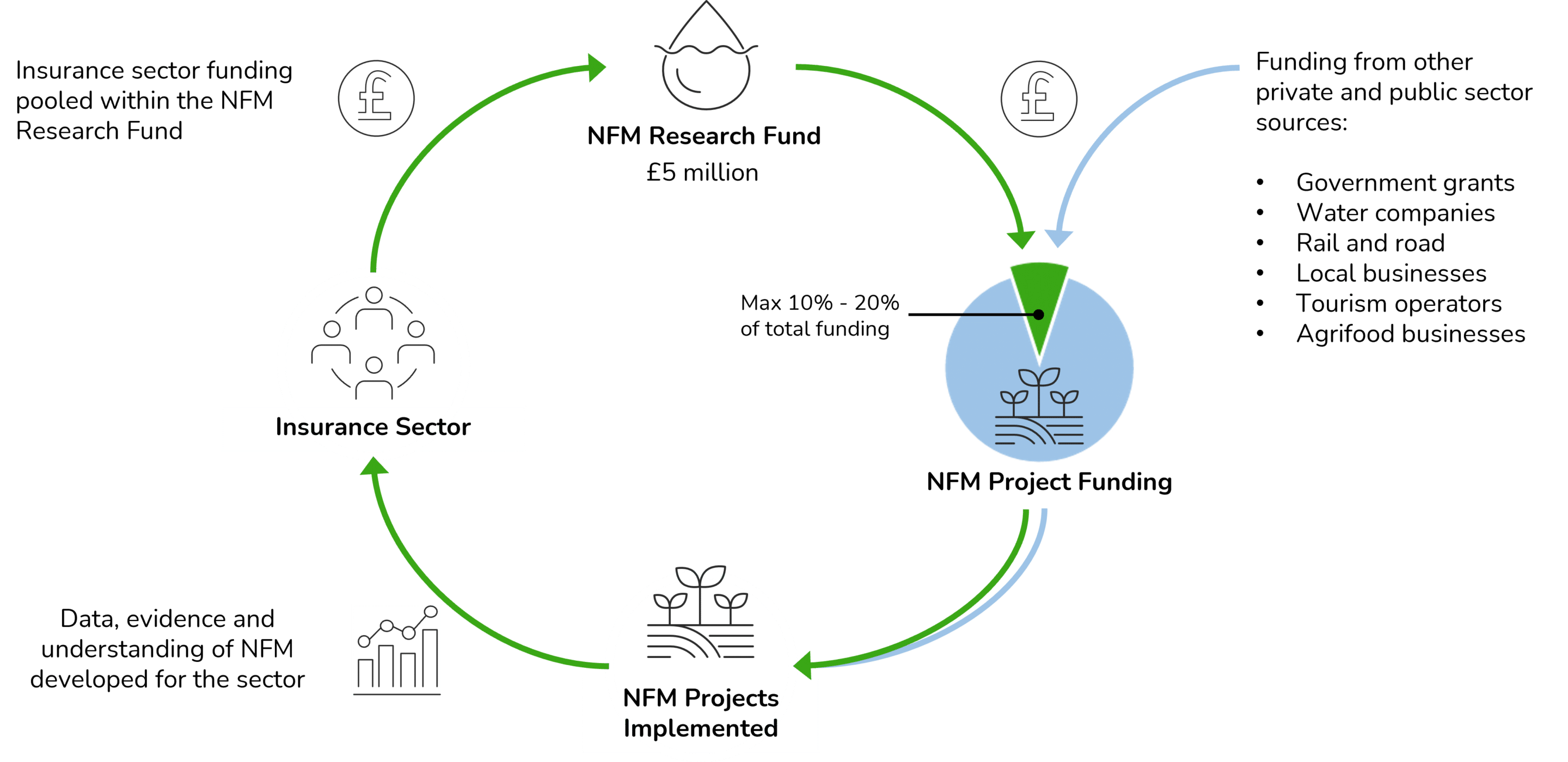
The NFM Research Fund

The NFM Research Fund pools capital from the insurance sector, to be deployed as non-repayable grants alongside other private sector NFM buyers, into NFM projects that are looking to bridge a funding gap.

This would marry the need of NFM project developers for a pool of funding that can purchase risk reduction, with the appetite of insurers to pay for greater evidence and commercial understanding of the impacts and benefits of NFM to the sector.


Read the paper here

Other content

dan-meyers-n6CKCAqQnhg-unsplash-scaled-830x553

27.04.26

Revenues for Nature: From Proven Models to Scalable Systems

The GFI Hive's latest report, “Revenues for Nature: From Proven Models to Scalable Systems,” distils insights from 60 revenue models and financing mechanisms across...

steven-weeks-DUPFowqI6oI-unsplash-scaled-830x553

16.04.26

Evaluating eligibility for transition finance: recognising the importance of nature

The GFI Hive team worked alongside the Transition Finance Council (TFC) on its Implementation Handbook: How to Apply the Transition Finance Guidelines, and as...

eutah-mizushima-OWwK_0_EnxY-unsplash-scaled-830x507

13.04.26

Accelerating High-Integrity Biodiversity Compensation Systems Worldwide

The Green Finance Institute has announced a new global partnership with the Wildlife Conservation Society, the Environmental Policy Innovation Center, Terrasos and UNDP Biofin...

paul-summers-ArtVJ-217Cw-unsplash-830x553

09.04.26

Getting Started with Nature Data and Metrics: How UK Businesses are Moving from Awareness to Action

Metrics and targets are the fourth pillar of the Taskforce on Nature-related Financial Disclosure’s (TNFD) recommended disclosures. Metrics provide a structured, decision-useful basis for...

manny-moreno-X9TEqJWmM6Q-unsplash-scaled-830x623

01.04.26

Revenues for Nature publishes Marine & Coastal Conservation Guidebook

The Revenues for Nature (R4N) Programme has published a guidebook focused on mechanisms that drive private capital into the protection and restoration of coastal...

iStock-1696166213-830x622

17.12.25

Creating a financial system that rewards nature restoration and impact reduction

All organisations and institutions working towards this target of large-scale traditional investment into nature restoration would benefit by collectively considering how we can address...