











Insights
Action for COP27: Reflections on Financing Nature’s Key Messages
Action for COP27: Reflections on Financing Nature’s Key Messages
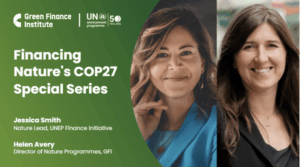
Leading up to COP27, the Green Finance Institute and the United Nations Environment Programme partnered on special series of the Financing Nature Podcast.
In this blog, co-hosts Helen Avery, GFI’s Director of Nature Programmes, and Jessica Smith, UNEP FI’s Nature Lead, reflect on the key messages that emerged.
The COP27 Financing Nature Series can be found on Apple, Spotify and Anchor FM.
We have 86 months left. The decade that began with a commitment to keep a planetary temperature rise within 1.5°C this century and the recognition that this could only happen if we collectively make radical changes and sweeping investments before 2030, is slowly slipping away.
As global leaders from governments, business, finance, and NGOs gather in Egypt for COP27, it is under the cloud of recent estimates from the United Nations Environment Programme (UNEP) that – even with the worldwide climate pledges made at COP26 – we are heading towards a planetary temperature rise of between 2.4°C and 2.6°C by 2100.
We have to increase our ambition. We have to turn pledges into on-the-ground investments. And we have to be more strategic about immediate solutions. That means ensuring nature, and investment at scale into nature’s restoration and protection, are embedded in discussions happening in Sharm El-Sheikh. There is no way to keep the 1.5°C ambition alive without stopping and reversing deforestation, transforming our food and land use systems, and protecting ocean ecosystems. More than 30% of the climate mitigation that is needed to achieve the Paris Agreement can come from nature-based solutions.
But, if the world is to meet its climate change, biodiversity, and land degradation targets, it needs to close a $4.1 trillion financing gap for nature by 2050. There is no time to lose.
In October, the Green Finance Institute and UNEP came together with this mission in mind, partnering on a COP27 Special Series of the Financing Nature podcast. Over five episodes we have spoken with global experts and local delivery partners to hear what we need from governments at COP27 to close this gap, and to showcase the crucial role private sector investment can play.
As the series concludes and the Conference gets underway, our guests have left us with clear messages:
1. Nature must be part of climate talks
3. There is a strong connection between economic growth, resilience, and nature
On the flip side to the previous point, connecting conservation, economic growth and resilience provides an opportunity that is crucial for us to remember. Guests expressed their concerns that previous ambition will be weakened at COP27 because of pressures on governments to address accelerating fuel costs and domestic cost of living crises. At COP26, nearly 200 countries agreed to upgrade their climate pledges by this year’s conference – yet only around two dozen have done so. It is therefore vital we understand that nature supports a thriving economy.
Kaddu Sebunya at the African Wildlife Foundation shared new models in Rwanda and Tanzania that have created win-win situations for local economies and conservation resulting in the expansion of a national park and mountain gorilla population and the development of schools, roads, hospitals, and housing. Yabanex Batista at the Global Coral Reef Fund shared the expanded opportunities for fishing communities from reef restoration in Mexico.
We were also reminded in this series how nature investments can reduce infrastructure costs. As an example, it’s about 50 times more cost effective over 15 years to protect a coral reef or a mangrove, than it is to build a seawall.
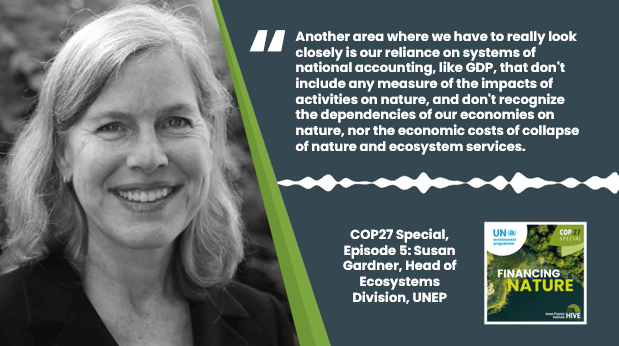
UNEP’s Susan Gardner shared that it is now time to look closely at our reliance on systems of national accounting, like GDP, that don’t include any measure of the impacts of activities on nature, and that don’t recognize the dependencies of our economies on nature, nor the economic costs of collapse of nature and ecosystem services.
4. We need greater risk-taking investment strategies from public sector capital
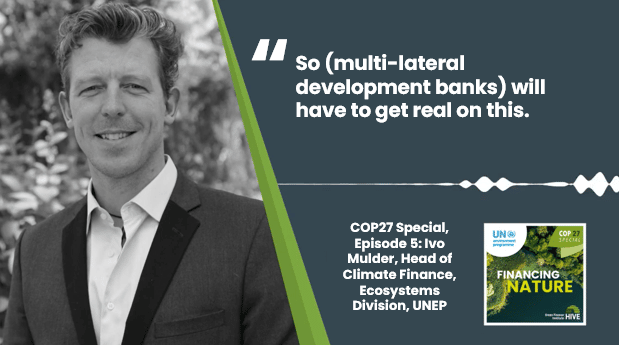
Across the episodes we heard that multi-lateral development banks (MDBs) and development finance institutions need to up their ambition and innovation in order to drive private capital investment into nature-based solutions. Ivo Mulder at UNEP called for MDBs to “get real”, pointing out that while they made big pledges at COP26, nature finance still represents a tiny percentage of their balance sheet. Andrew Deutz at The Nature Conservancy stressed the need for development banks to set portfolio targets for nature, in the same way that they have set targets for low carbon.
An increased use of guarantees and political risk insurance was also repeatedly highlighted by guests, with examples of how this de-risking has resulted in several successful deals to date including the Belize Blue Bonds. Deutz also put forward the practical need to revisit banks’ internal accounting rules so that guarantees are not considered the same as loans on a balance sheet.
5. Sovereign debt restructuring can be linked to climate and conservation
Several guests made the link between sovereign debt and nature investment. We are on the cusp of a sovereign debt crisis, and there is an opportunity to restructure that debt and link it to climate and conservation KPIs – again if the IMF signals direction, and MDBs provide greater de-risking, said Deutz. Rough estimates by the Nature Conservancy point to $2 trillion of debt that could be restructured with such outcomes embedded.
6. We need to support communities in building capacity on the ground
All guests highlighted the value of investment readiness programmes or accelerator programmes that help develop bankable or investable projects and solutions on the ground, including a need for aggregation models that can bring smaller projects or enterprises together to appeal to larger investors.
Ultimately it is communities on the ground and non-profits that will deliver nature restoration, said Yasmine Sagita at Royal Lestari Utama, and so funding for development and training must be provided.
David Cheboryot at E4 Impact Foundation echoed the importance of funding to support capacity building, and to help projects and enterprises find a route to market. Philanthropy or technical assistance grants from governments can play a much larger role here, helping to fund projects that can then catalyse private capital and become sustainable.
Eighty-six months is not long, but it is enough if we do not waste a moment of it. It is up to all of us to keep applying pressure to our governments, businesses and financial institutions, and to take practical steps to move investment at scale into change on the ground, so that we can keep the 1.5°C ambition alive and turn the tide on biodiversity loss for people and planet.
COP27 offers us a collective opportunity to do so, and we hope you will join us in sharing these messages.
The COP27 Financing Nature Series can be found on Apple, Spotify and Anchor FM.
Many thanks to our guests for joining us on this special podcast series:
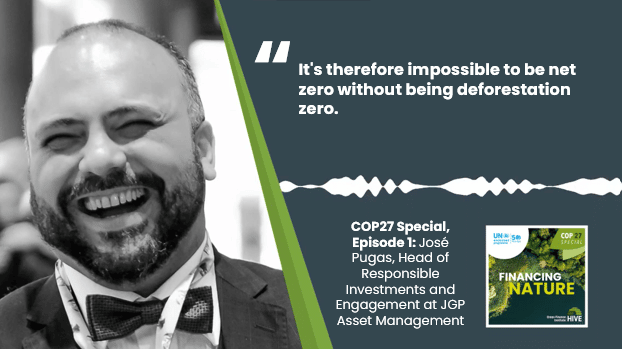
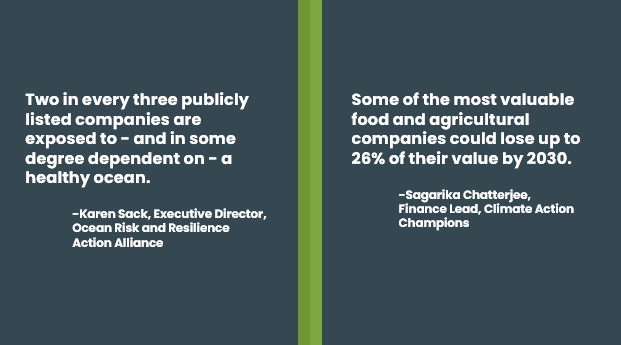
- Episode 1: Sagarika Chatterjee, Finance Lead, Climate Action Champions to discuss the Glasgow Financial Alliance for Net Zero & José Pugas, head of responsible investments and engagement at JGP Asset Management in Brazil to discuss the work of the IFACC
- Episode 2: Andrew Deutz, Director of Global Policy, Institutions and Conservation Finance at The Nature Conservancy & Yasmine Sagita, Chief of People, Sustainability and Corporate Affairs at rubber company, PT Royal Lestari Utama (RLU) to discuss the Tropical Landscape Finance Facility
- Episode 3: Kaddu Sebunya, CEO, African Wildlife Foundation & David Cheboryot, Director of Entrepreneurship Centres – Africa – E4Impact Foundation
- Episode 4: Karen Sack, executive director at the Ocean Risk and Resilience Action Alliance & Yabanex Batista, Deputy Head of the UN’s Global Team for The Global Fund for Coral Reefs
- Episode 5: Susan Gardner, Head of the Ecosystems Division at UNEP and Ivo Mulder, Head of the Climate Finance Unit, Ecosystems Division, UNEP
Other content
08.06.26
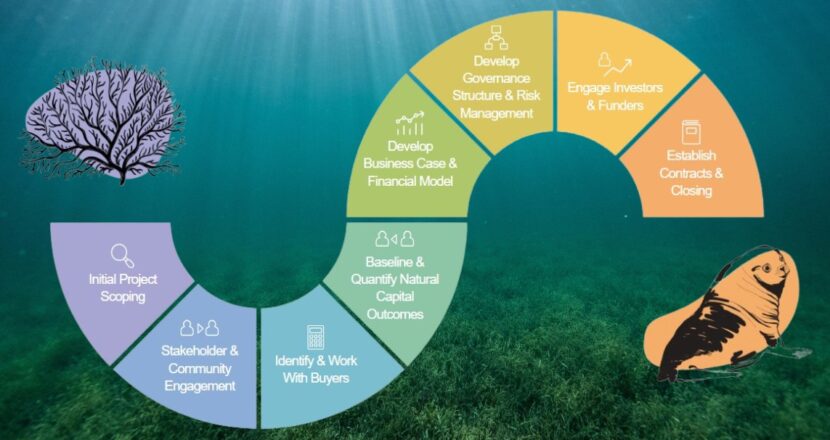
Unlocking Finance for Marine and Coastal Nature Recovery in the UK
Marine and coastal restoration projects can deliver significant environmental, social and economic benefits, but many struggle to access the funding and finance needed to...
27.04.26
Revenues for Nature: From Proven Models to Scalable Systems
The GFI Hive's latest report, “Revenues for Nature: From Proven Models to Scalable Systems,” distils insights from 60 revenue models and financing mechanisms across...

16.04.26
Evaluating eligibility for transition finance: recognising the importance of nature
The GFI Hive team worked alongside the Transition Finance Council (TFC) on its Implementation Handbook: How to Apply the Transition Finance Guidelines, and as...

13.04.26
Accelerating High-Integrity Biodiversity Compensation Systems Worldwide
The Green Finance Institute has announced a new global partnership with the Wildlife Conservation Society, the Environmental Policy Innovation Center, Terrasos and UNDP Biofin...

09.04.26
Getting Started with Nature Data and Metrics: How UK Businesses are Moving from Awareness to Action
Metrics and targets are the fourth pillar of the Taskforce on Nature-related Financial Disclosure’s (TNFD) recommended disclosures. Metrics provide a structured, decision-useful basis for...
01.04.26
Revenues for Nature publishes Marine & Coastal Conservation Guidebook
The Revenues for Nature (R4N) Programme has published a guidebook focused on mechanisms that drive private capital into the protection and restoration of coastal...