












Insights
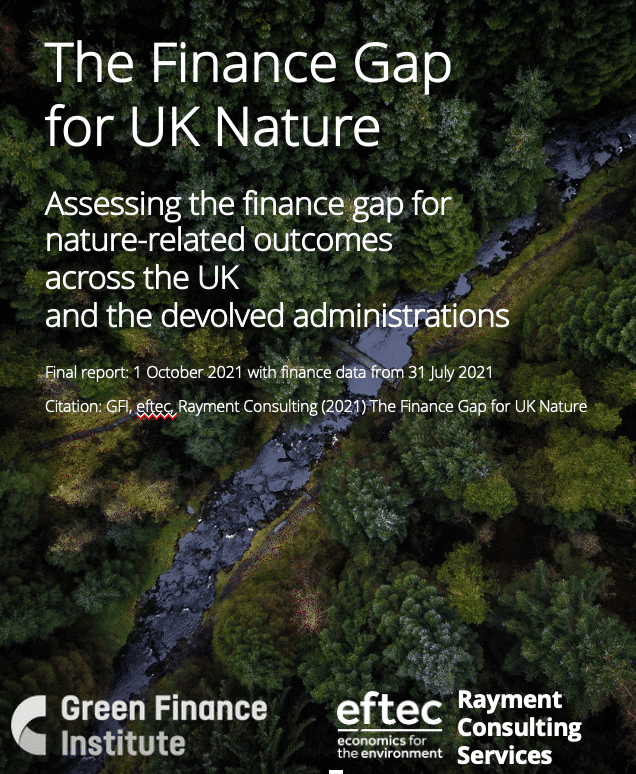
Finance Gap for UK Nature Report
Finance Gap for UK Nature Report

Oct 12, 2021
The Green Finance Institute commissioned environmental economics consultancy, eftec, to identify the finance gap across the UK to achieve nature-positive outcomes in order to assess the need for private investment.
Please find below the press release, full report and appendix 2 along with an interactive map that highlights the gaps for England, Scotland, Wales, Northern Ireland and the Overseas Territories by specific nature-related outcomes.

Dr Rhian-Mari Thomas OBE
CEO, The Green Finance Institute
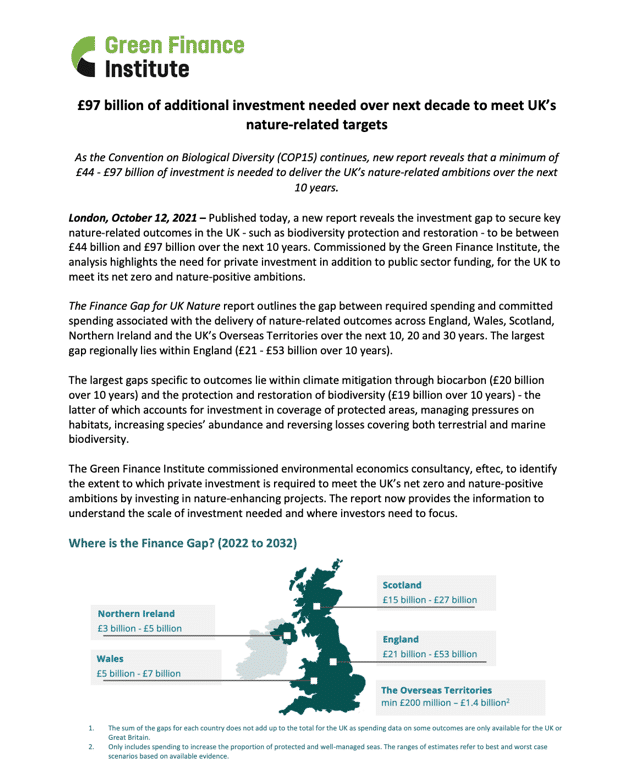
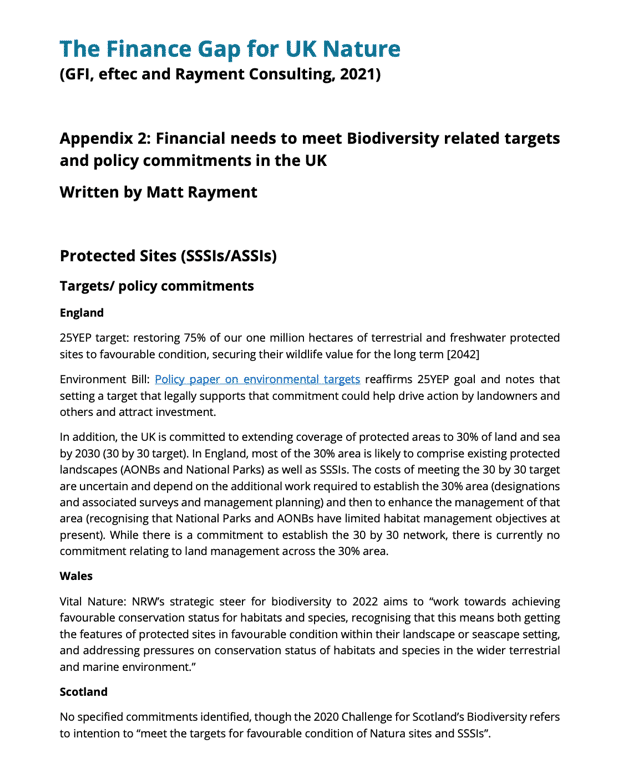
Map Of Finance Gap By Region, Outcome And Output
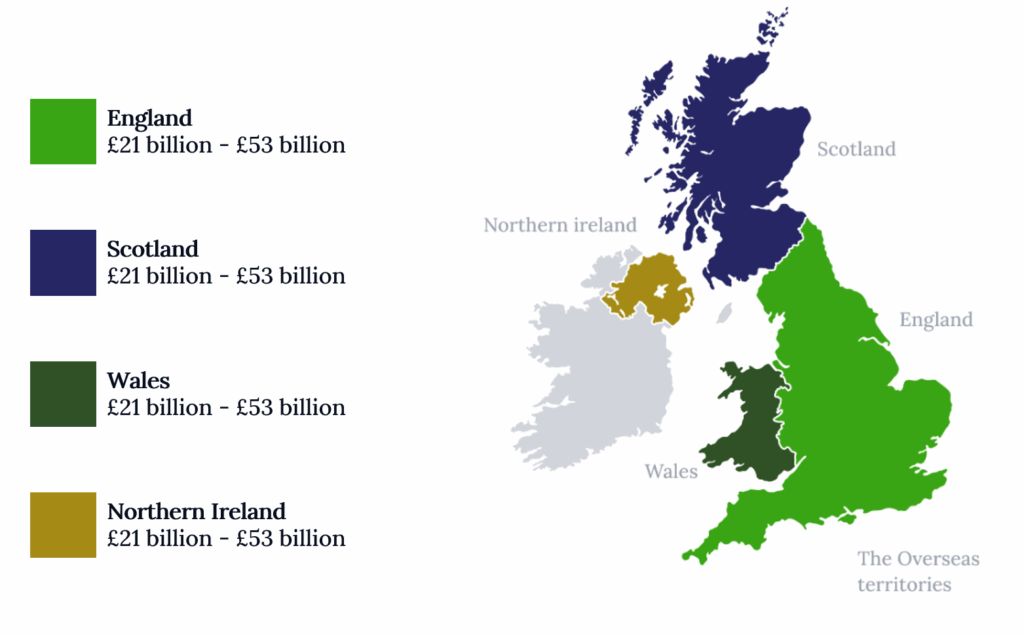
Finance gap for UK by outcomes (central estimates)

Clean Water
£8 billion
(£5 billion – £15 billion)

Protect and/or restore biodiversity
£19 billion
(£13 billion – £32 billion)

Reduce flood risk through natural flood management
£354 million
(£171 million – £747 million)

Improve bio-resource efficiency
£4 billion
(£4 billion – £5 billion)

Climate mitigation through bio-carbon
£20 billion
(£20 billion – £21 billion)

Enhance biosecurity
£109 million
(£0 – £4 billion)

Improve access and engagement with the natural environment
£7 billion
(£6 billion – £30 billion)

Spending with multiple outcomes (overlaps)
£4 billion
(£4 billion – £10 billion, or 6-10% of overall gap)
Other content
08.06.26
Unlocking Finance for Marine and Coastal Nature Recovery in the UK
Marine and coastal restoration projects can deliver significant environmental, social and economic benefits, but many struggle to access the funding and finance needed to...
27.04.26
Revenues for Nature: From Proven Models to Scalable Systems
The GFI Hive's latest report, “Revenues for Nature: From Proven Models to Scalable Systems,” distils insights from 60 revenue models and financing mechanisms across...

16.04.26
Evaluating eligibility for transition finance: recognising the importance of nature
The GFI Hive team worked alongside the Transition Finance Council (TFC) on its Implementation Handbook: How to Apply the Transition Finance Guidelines, and as...

13.04.26
Accelerating High-Integrity Biodiversity Compensation Systems Worldwide
The Green Finance Institute has announced a new global partnership with the Wildlife Conservation Society, the Environmental Policy Innovation Center, Terrasos and UNDP Biofin...

09.04.26
Getting Started with Nature Data and Metrics: How UK Businesses are Moving from Awareness to Action
Metrics and targets are the fourth pillar of the Taskforce on Nature-related Financial Disclosure’s (TNFD) recommended disclosures. Metrics provide a structured, decision-useful basis for...

01.04.26
Revenues for Nature publishes Marine & Coastal Conservation Guidebook
The Revenues for Nature (R4N) Programme has published a guidebook focused on mechanisms that drive private capital into the protection and restoration of coastal...